MQL vs SQL: What You Need to Know for Printers

Most companies, printers included, haven’t spent the time to define their sales process or the stages a prospect goes through before they buy. Even still, there are several more companies who have discrepancies in their sales process depending who you ask. Defining this process isn’t an easy exercise to go through, but it’s very necessary. And, having it well-defined will help you grow, follow up with sales opportunities, and streamline your sales process. But, what does that have to do with MQLs and SQLs? MQL VS SQL An MQL is defined as a Marketing Qualified Lead. It’s a print buyer who’s still a prospect but has indicated a level of interest in buying some sort of printing or services from your print business. This person is deemed likely to become a future customer after some nurturing. An SQL is defined as a Sales Qualified Lead. An SQL is a print buyer who started as a prospect and has shown high levels of interest in buying printing from you. They’ve shown that interest through a set of specific actions and are highly likely to then convert into a paying customer. This is someone who’s ready to speak to you about something
How to Make an Idea Stick

The Golden Touch Do you have anyone in your life a bit like Midas? You know, where everything they touch turns to gold? It seems favor follows them at every turn and they garner respect wherever they go. While not all of us possess that charismatic charm, it is possible to grow in our delivery. And that starts with compelling communication. Creating the Framework for Ideas that Stick How is it that some people can share their ideas in a way that resonates so well with their audience, while others can drop a great idea that falls completely flat? This month’s marketing tip, available on every website provided by Marketing Ideas For Printers, offers your clients a framework for creating memorable, useful content for their flyers, business cards, banners, and more. This framework starts with five key questions: Does your content make people: Pay attention? Understand and remember it? Agree/Believe? Care? Be able to act on the message? Bringing in Emotion Businesses want people to remember the idea — so it’s essential to make it feel concrete. When readers care about an idea, they are one step closer to buying into the overall concept, and ideas become more “sticky.” Frame
Yes, Your Print Shop Really Does Need a Print MIS Solution

“Does my print shop really need a Print MIS Solution?” The short answer to that question is: Yes! And here’s why… Print MIS Explained MIS is an abbreviation for “Management Information System.” Like most manufacturing businesses, the printing industry requires juggling a lot of information to function profitably. An MIS solution helps you with the juggling, and therefore, the profits! Here are some examples of the types of information a Print MIS solution will manage for you: Customer names and contact info Paper cost Ink cost Click cost Hourly rates of each piece of equipment in your shop Boxes Tape Overhead Accounts receivables Account aging Sales commissions You get the idea. Although it might seem like an overabundance of bullet points there, that’s really just scratching the surface of the knowledge you can have at your fingertips with a Print MIS solution for your print business. Back in 2006, we implemented our first robust MIS solution. We were able to prepare estimates so fast that many customers reported that we had delivered the completed job before our competition even delivered pricing! A Rocky Path to an Imperfect Result Take a minute to picture this and see if it sounds familiar:
Size Doesn’t Matter. Your Customers Do.

The size of your print business is not a predictor of its success. In fact, there’s really only one thing that will help you know how successful you’ll be — your customers! Think about it: Whether it’s a large business like Google or Amazon or a much smaller, local mom and pop shop, customers are the one aspect that tie all businesses together. Your customer base is the greatest treasure you’ll ever hold, so it’s important you treat it as such. Consider that: “47 percent of customers surveyed have switched companies after a single instance of poor customer service,” according to 24/7. “A customer who is “totally satisfied” delivers 2.6 times as much revenue as one who is “somewhat satisfied.” So, how do you go about maintaining your customer base and still make your business stand out from others? The answer is: Go the Extra Mile. “Yeah, I get that,” you say. “But how?” Communication is Your First Step Not everyone is naturally a great communicator. It’s important to remember that communication is a learned skill, and you need to take the time to train your Customer Service Representatives on what to ask. For example, train your staff to run through these five
3 Steps to Crafting A Marketing Message Your Ideal Buyers Will Love (Part 4: Empathy Map)

Crafting a marketing message that will resonate with your buyers is no easy task. But, if you first determine the who, the what, and the how, you’ll be well on your way to a compelling message. This week, in part four of this series, you’ll learn how to expand on what you’ve learned about the “how” thus far with an impactful tool called an empathy map. Understanding is Vital Empathy = understanding, and it’s something you cannot ignore. If you want to understand your audience, you have to be able to enter the conversation that’s already playing in your prospect’s head. By matching up with their values and worldviews, you’re also aiming to open the conversation in the prospect’s heart, and that’s how your marketing triggers the right motivation at the right time. The Process of Empathy Mapping At the crux of this exercise is this statement: “Our ideal customer needs a better way to ____ because ____.” Your empathy map will be different from anyone else’s, but it should have these foundational elements: Four quadrants broken down into “think/feel,” “see,” “say/do,” and “hear.” Two optional boxes at the bottom of the quadrants: “Pains” and “Gains.” The point of this map
Best Practices = Better Products

While there are many powerful software suites available on the market today, few are as accomplished as Adobe InDesign. But with its large number of buttons and gadgets, this publishing software can be intimidating for novice designers. The June Ideas Collection tech tip, available on every website provided by Marketing Ideas For Printers, will walk your audience through six “best practices” for Adobe InDesign. Here are three points to preview from this month’s article: 1. Begin at the End Ever complete a design only to find you were missing proper fonts or that your images were improperly linked? InDesign offers “Live Preflight,” which allows clients to see problems with the file before it is sent for printing. 2. Thread That Text Often we get bogged down and frustrated by tasks that were supposed to be simple. Placing long blocks of text can be a headache, but InDesign allows users to “thread” text, flowing content from frame to frame. This allows for effortless changes to text boxes, layouts, and a more cohesive story that evenly breaks across pages. 3. Keep Formatting Consistent Even experienced designers can find their font, sizing, and colors losing consistency throughout a printed piece. InDesign overcomes this
3 Steps to Crafting A Marketing Message Your Ideal Buyers Will Love (Part 2: What)

In part one of “3 Steps to Crafting A Marketing Message Your Ideal Buyers Will Love,” we talked about how your messaging is the core that will drive your entire business. You learned that the first step to great a message is the “Who.” To whom is your message directed at? If you haven’t created a buyer persona, you’ll want to go back and make sure you complete that step. After all, if you don’t have your “who,” you won’t be able to move on to the “what” of your message. First Come Who, Then Comes What Once you’ve gone through the persona process, and you have a good idea of who your audience is, you’ll want to figure out what it is exactly that they need to hear from you. When you’re able to craft the right message at the right time, and to the right people, you’ll get more leads and, ultimately, more sales. There ain’t nothin’ better than leads and prospects that proactively reach out to you to buy. So, how do you do that? The Power of Empathy First, you’ll want to learn how to have and show empathy. Empathy is the art of putting yourself in
The Ultimate Print Guide for Your Customers
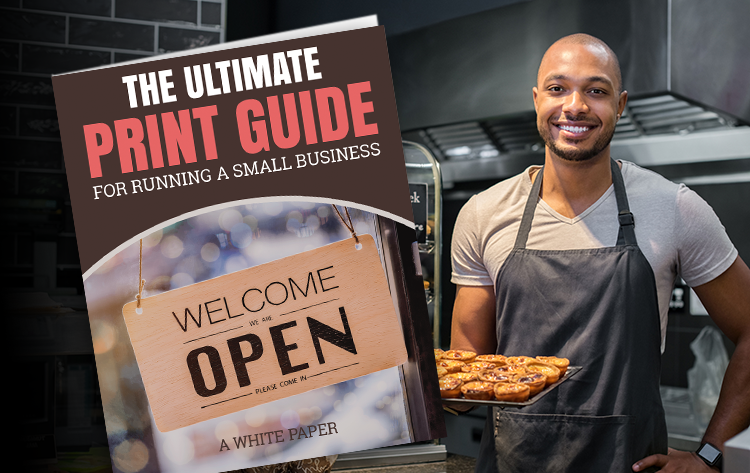
Let’s be honest, sometimes entrepreneurs and small business owners just don’t know where to start with their print resources. They get their business cards, maybe a sign, some flyers and brochures and then they don’t know what else to do – or think they don’t really need anything else. The Tool You Need for Your Customers The Ultimate Print Guide for Running a Small Business is a compact and useful tool for understanding what new business owners need to market and run their business. It is the perfect guide for inspiring your customers and simplifying their print needs into something they can understand and get excited about. The Perfect Guide The guide covers everything from PR needs and traditional marketing materials to forms and employee manuals. The Set, Camera, Lights! section dissects the need for great images of products and what to consider if taking the photos themselves vs. having them professionally done or using stock photos. After all, nothing ruins a great flyer like an amateur photo. The section on direct mail and other direct marketing materials lays out a good foundation to increase exposure and sales in simple steps with the potential for big results. Combine that with the section
Outserve Your Competition: The Power of Great Customer Service

Recently, I was having a conversation with a fellow print shop owner, and the topic of customer service came up. I mentioned that I thought customer service was more important than it ever has been in my 30-year career in the printing industry. He disagreed. “As long as I deliver a quality product in a timely manner everything works out great for me,” he said. I’m not so sure about that. Allow me to share my opinion on my friend’s opinion. There was a time in our industry that quality and speed would allow a printing business to charge a hefty price, rake in the dough, and control market share in their market. In our new digital world, though, expectations are already high. Quality is not expected, it’s required. And speed? Ever since the microwave was introduced, society has been trying to figure out how to make the world spin faster on its axis! To make matters worse, now that anyone can get into the digital printing business, there have been a bunch of newbies enter the print industry that have no clue how to price their products appropriately. That means it’s even more challenging to compete for the same margins
How to Create Arresting Designs You Can’t Look Away From

What scenes are so arresting you simply cannot look away? Peter Friederici of Orion magazine listed nine apprehending images including these: A single star shining through low clouds lit orange by the glow of streetlights. A ship interrupting the smooth expanse of any horizon . . . because a vessel on the water is a story whose arc you simply have to follow. How to “Lure” Your Audience Want to equip customers to apprehend viewers with their own arresting images? Sleek, compelling designs can make it difficult to look away! This month’s design tip, added to every website provided by Marketing Ideas For Printers, offers a few tricks for luring in viewers: “Good design understands that your eyes are sending information to your brain at an astounding rate. But because your brain cannot possibly capture every detail, sometimes it sees the edges of a particular image and fills in the missing pieces of the puzzle based on your previous life experience. By capitalizing on this thought, you can use clever design ideas that will gently encourage viewers to follow your lead.” Here are a few keys from the article to educate your clients: Fancy Brain Tricks Use optical illusions, colors,
The MI4P Process
This two-minute video will show you how we take you through Our Proven Process. No surprises; no bumps in the road!
It's worked for hundreds of printers just like you; it will work for you, too! Download the MI4P Proven Process PDF below, and follow along.
PDF: The MI4P ProcessSay Hello
"*" indicates required fields
Who We Are
What We Do
Marketing Ideas For Printers
5990 14th Street South
Fargo, ND 58104
(701) 241-9204 (800) 736-0688
© 2026 Marketing Ideas For Printers
Our Privacy Policy | Terms of Service