How White Papers Help You Sell More Printing
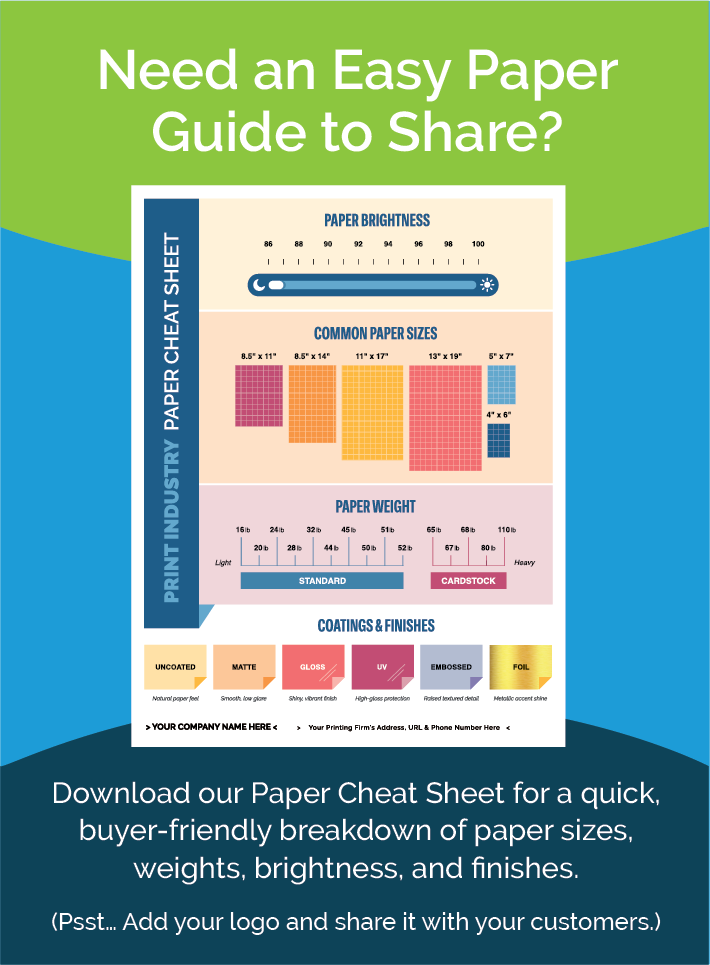
All printers want to sell more printing, but many tend to overlook the impact that white papers have on reaching that goal. What are White Papers? A white paper is an “authoritative report or guide meant to help readers understand an issue, solve a problem, or make a decision”. They provide an in-depth study on a specific topic. What’s great about providing your print buyers with white paper content is YOU are the authority in that definition, and you’re using that authority to help your audience solve their sales or marketing problems using print. The Benefits of White Papers for Printing and Marketing Companies Along with addressing or solving a problem for the reader (which is a benefit in and of itself), white papers offer many other benefits as well. White papers help generate leads. White papers help you be seen as an industry thought leader. White papers are typically geared towards a B2B focus, building powerful corporate relationships that help shore up your bottom line. White papers give you an edge over the competition when used as a valuable resource to your print buyers. White papers help influence the buying decisions of your print buyers. A 2015 Eccolo Media
How to Breathe New Life into Your Marketing and Sales Tactics

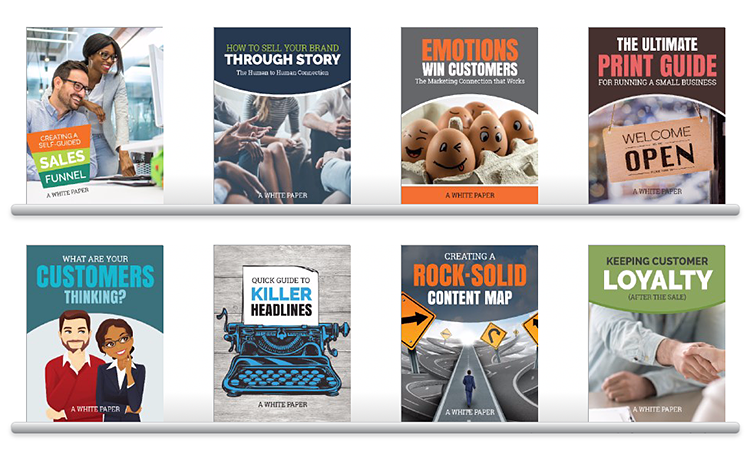
As small business owners, we wear a lot of hats, making it nearly impossible to give our complete focus to every role. That’s usually why when it comes to the marketing and selling for our print companies, we often rely on what we’ve always done simply because it’s comfortable. After all, it’s easier to focus on other pressing responsibilities. Over time, though, a lack of fresh ideas can leave your sales and marketing efforts on an unpleasant plateau and cause you to fall behind in an industry that is continuously moving forward. Those strategies that worked in the past may still have a place in the future, but it’s critical to take a step back every so often to take an inventory of what’s working and what’s not. When you reassess your objectives for the year and explore how these objectives will align with your marketing strategies, you’ll be able to look at your printing company through a fresh lens. Here are four steps to help you get started: 1. Examine What Worked, What Didn’t, and What is “SO Last Year.” Every year (at least!), these are the types of questions you should be asking yourself to ensure your business
Who Needs Marketing? You do!
Who needs marketing? Things are great. I’m busier than ever, and profits are through the roof! In fact, I don’t want or need any more business. All of that may be true. This has been an incredible run. Nine years of economic growth. Not a record, but it’s certainly has been a great ride. I hope it continues for nine more years. However, if it doesn’t, I’m prepared because I don’t see my future and the future of my company hinging on the whim of the economy. Here are three fundamental reasons why any company should always invest in marketing. 1) The good times never last. Come on admit it, they never do. The economy will change, and, when it does, are you prepared? Is your brand prepared? Is your brand memorable, even in a downturn? Will customers choose you over someone else in difficult times? Or better yet, will they remember you when their wallets get tight? This economy will change, and it will affect your business. This is why it’s so essential to plant those marketing seeds today, so you can harvest when times aren’t quite so bright. “Winter’s coming.” Sorry for the cliché. But it is true.
MQL vs SQL: What You Need to Know for Printers

Most companies, printers included, haven’t spent the time to define their sales process or the stages a prospect goes through before they buy. Even still, there are several more companies who have discrepancies in their sales process depending who you ask. Defining this process isn’t an easy exercise to go through, but it’s very necessary. And, having it well-defined will help you grow, follow up with sales opportunities, and streamline your sales process. But, what does that have to do with MQLs and SQLs? MQL VS SQL An MQL is defined as a Marketing Qualified Lead. It’s a print buyer who’s still a prospect but has indicated a level of interest in buying some sort of printing or services from your print business. This person is deemed likely to become a future customer after some nurturing. An SQL is defined as a Sales Qualified Lead. An SQL is a print buyer who started as a prospect and has shown high levels of interest in buying printing from you. They’ve shown that interest through a set of specific actions and are highly likely to then convert into a paying customer. This is someone who’s ready to speak to you about something
How to Make an Idea Stick

The Golden Touch Do you have anyone in your life a bit like Midas? You know, where everything they touch turns to gold? It seems favor follows them at every turn and they garner respect wherever they go. While not all of us possess that charismatic charm, it is possible to grow in our delivery. And that starts with compelling communication. Creating the Framework for Ideas that Stick How is it that some people can share their ideas in a way that resonates so well with their audience, while others can drop a great idea that falls completely flat? This month’s marketing tip, available on every website provided by Marketing Ideas For Printers, offers your clients a framework for creating memorable, useful content for their flyers, business cards, banners, and more. This framework starts with five key questions: Does your content make people: Pay attention? Understand and remember it? Agree/Believe? Care? Be able to act on the message? Bringing in Emotion Businesses want people to remember the idea — so it’s essential to make it feel concrete. When readers care about an idea, they are one step closer to buying into the overall concept, and ideas become more “sticky.” Frame
Top 10 Mistakes Printers Make When Marketing Themselves

Your branding and marketing are the lifeblood of your business, and they are worth your time and energy to learn to do right. If this is new territory for you, sometimes the best way to make sure you’re on the right path means simply learning to recognize the wrong one. Check out these top ten mistakes printers make with their branding and marketing below. 1. Not Selling Your Differentiator If the message of your brand is “We’re the best print company ever!”, you’re not going to sound much different than your competition or make it very far. I mean, have you ever seen a company advertise, “We’re not the best, but we try really hard!”? Probably not. This is why it’s so important to focus on what makes you unique. Voice your differences and learn to think outside the box of mediocrity. Build your message around what makes your customers keep coming back to you. Is it your customer service? Your referral program? Aim narrow and hit hard. 2. Thinking Locally Instead of Globally Remember, you’re reaching an online audience now, not just your local customers. Thinking you’re unique by using CMYK colors in your branding or trying to be
3 Steps to Crafting A Marketing Message Your Ideal Buyers Will Love (Part 4: Empathy Map)

Crafting a marketing message that will resonate with your buyers is no easy task. But, if you first determine the who, the what, and the how, you’ll be well on your way to a compelling message. This week, in part four of this series, you’ll learn how to expand on what you’ve learned about the “how” thus far with an impactful tool called an empathy map. Understanding is Vital Empathy = understanding, and it’s something you cannot ignore. If you want to understand your audience, you have to be able to enter the conversation that’s already playing in your prospect’s head. By matching up with their values and worldviews, you’re also aiming to open the conversation in the prospect’s heart, and that’s how your marketing triggers the right motivation at the right time. The Process of Empathy Mapping At the crux of this exercise is this statement: “Our ideal customer needs a better way to ____ because ____.” Your empathy map will be different from anyone else’s, but it should have these foundational elements: Four quadrants broken down into “think/feel,” “see,” “say/do,” and “hear.” Two optional boxes at the bottom of the quadrants: “Pains” and “Gains.” The point of this map
3 Steps to Crafting A Marketing Message Your Ideal Buyers Will Love (Part 3: How)

So far in this series of crafting your perfect marketing message, you’ve learned about the who and the what in order to craft the messages your prospects need to hear. To recap: The “who” reveals the stories you should tell by knowing your audience. The “what” helps you craft an overall voice that ties directly into the prospect’s motivation to buy. Once these two parts are nailed down, you’ll be able to deliver the perfect metaphors and anecdotes that make your ideal prospect view you as the only choice. This messaging and content will be a clear combination of messages that are persuasive, compelling, and powerful for them to hear and read. You Are Not Your Audience Armed with the “who” and the “what,” let’s turn our attention to look at the “how” of attracting your ideal buyer — one who shares your values. When you’re just getting started executing your “how,” it can be tempting to overly identify with your audience. While you’re going to have things in common, it’s dangerous to think your ideal customer is similar to you in other ways. You’re a subject matter expert at what you do, for starters, and they are not. Make sure to
Outserve Your Competition: The Power of Great Customer Service

Recently, I was having a conversation with a fellow print shop owner, and the topic of customer service came up. I mentioned that I thought customer service was more important than it ever has been in my 30-year career in the printing industry. He disagreed. “As long as I deliver a quality product in a timely manner everything works out great for me,” he said. I’m not so sure about that. Allow me to share my opinion on my friend’s opinion. There was a time in our industry that quality and speed would allow a printing business to charge a hefty price, rake in the dough, and control market share in their market. In our new digital world, though, expectations are already high. Quality is not expected, it’s required. And speed? Ever since the microwave was introduced, society has been trying to figure out how to make the world spin faster on its axis! To make matters worse, now that anyone can get into the digital printing business, there have been a bunch of newbies enter the print industry that have no clue how to price their products appropriately. That means it’s even more challenging to compete for the same margins
3 Steps to Crafting A Marketing Message Your Ideal Buyers Will Love (Part 1: Who)

Messaging is everything. It drives your entire business, should be crafted synonymously with your core values, and built around a clear, compelling reason why your prospects should want to do business with you. Yet, the majority of printers have no core messaging, and no relevant message strategy (other than to sell something somebody wants). So, how do you craft content and messaging that’s irresistible to your prospects, and at the same time clearly explains the value you offer your buyers and how you can help them? Over the next four weeks, you’ll learn three steps to help you create a marketing message your ideal buyers will love, plus we’ll walk you through an invaluable exercise called The Empathy Map. The Who Before you can get someone to buy from you, you need to know what to say to them, and how to say it. You’ll never get that right unless you know who you’re talking to. Here at Marketing Ideas For Printers, we call this creating buyer personas. You could call them avatars or even characters if you prefer. It’s All in the Research The main idea is to create a fictional representation of your ideal customer or persona. To create
The MI4P Process
This two-minute video will show you how we take you through Our Proven Process. No surprises; no bumps in the road!
It's worked for hundreds of printers just like you; it will work for you, too! Download the MI4P Proven Process PDF below, and follow along.
PDF: The MI4P ProcessSay Hello
"*" indicates required fields
Who We Are
What We Do
Marketing Ideas For Printers
5990 14th Street South
Fargo, ND 58104
(701) 241-9204 (800) 736-0688
© 2026 Marketing Ideas For Printers
Our Privacy Policy | Terms of Service