11 Checklist Questions to Help You Spot an Online Imposter
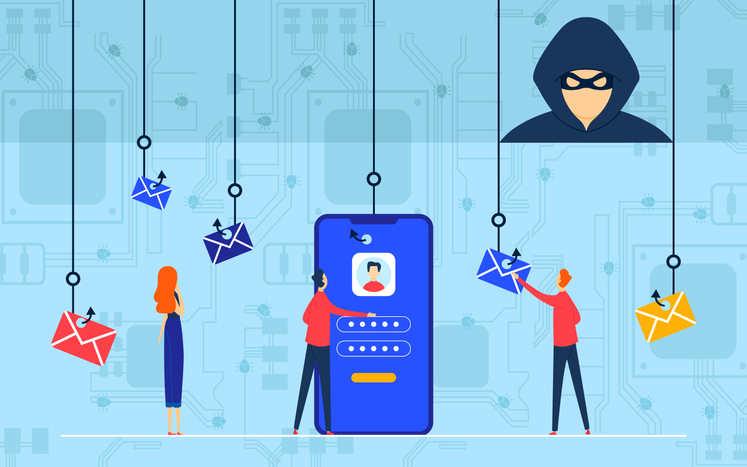
Imposters online can make your life miserable. If you miss the signs and end up welcoming them into your connection circles, it can only mean one thing – bad news! Take a look at the questions below that you can use to help determine the truth from a lie. Social Media 1.) Is the profile picture featured a legitimate photo? If the photo is left blank, contains an avatar, features a model, or is simply low-quality, be suspicious and ask yourself if the connection request is worth the risk. 2.) Have I checked their username? Fake profiles will typically feature foreign usernames or usernames that contain numbers. While it would be almost impossible to tell if an account was fake simply by the username, it could be one more warning sign when combined with everything else. 3.) Does their bio make sense? Before connecting with anyone online, please do your due diligence to find out what they’re all about. If their bio features suspicious links or incorrect English (grammar, not spelling), you’ll want to steer clear. 4.) What type of content have they shared? If their account doesn’t have any recent activity, or they tend only to reshare content and
Estimating For Printers: 5 Do’s and Don’ts to Get Print Buyers to Say Yes!

Estimating a job correctly is essential to owning and operating a print business. Over-estimate, and you risk losing the sale because you’re too expensive. Under-estimate and your bottom line suffers. This is why making sure you hit the bullseye with your estimating is so important — because everyone wins! How can you ensure a “Goldilocks” estimate every time — one where the clients say yes AND you hit your sales and profit numbers? You follow these five best practices for estimating. Best Practices for Estimating: 5 Do’s and Don’ts Don’t: Guess on Your Numbers Guessing is for board games and riddles, not for your print estimates. Estimating is not an area where you want to cut corners and base your figures on assumptions. You either need to ask prospects for the information you need yourself or invest in an estimating solution that will ensure you leave yourself enough margin with every job, big or small. Do: Ensure Accuracy You can ensure the accuracy of your estimates by taking the time to understand what the project involves. When you eliminate all of those “ballpark figures” and are able to quote precisely, you’ll be able to decide whether you want to take
eCommerce For Printers: Online Payments and PCI Compliance

Ecommerce is no longer a “wave of the future.” It’s a necessity. As part of that expectation, consumers are counting on your printing firm to be able to take credit card payments through your website and be trusted with the transaction details. Remember the pre-internet days of taking a credit card payment? You lugged that big slider thingy up onto the counter, put your NCR receipt paper in there with the credit card, and then slid it back and forth a dozen times until you magically created a semi-readable etching of the information. Ahh… those were the days; life was slower back then. Today, however, life’s quickened pace has meant that credit card payments have to hit on all markers of fast, secure, and safe. The creation of the digital space and the Amazon-like ordering experience means consumers, small business owners, and credit card companies need a way to protect themselves against digital fraud. Data and information need to be protected with just as much fervor as physical currency. And, if your printing firm wants to take credit card payments via your website, that’s where PCI compliance comes in. What is PCI Compliance? Payment card industry (PCI) compliance is a
3+ Ways to Make Your Website Your Greatest Salesperson

It’s the first thing people look at when researching a company, yet almost always overlooked when considering their sales team. Your website can easily be your top sales performer and the greatest “hire” you’ll ever make. Consider what Claire Emerson of Copyblogger says, “Your website doesn’t take breaks, it won’t call in sick, and it’s focused on getting the results you want.” Are you overlooking the sales impact your website can make? 3 Ways to Make Your Website Your Greatest Salesperson 1. Interview Your Website. That may sound corny, but think of it this way: did you interview the salespeople you have on your team now? Of course, you did! Start by creating a list of “interview questions” that you can use to evaluate your website. For example, Does your website know and display everything about your print business that it should? Are you reviewing your website’s success on a regular basis? Do you offer your website “training” (i.e., content) on the questions your print buyers are asking? Does your website promote and use all of your current product offerings, services, and pricing? When you hire an employee, you give him or her your time and attention to help improve
5 Ways to Simplify Online Ordering for Your Print Buyers

Did you know that your printing company’s online ordering process can quite literally set the tone for your customers? Especially now, when 68% of consumers have elevated their expectations of a company’s digital capabilities because of the COVID-19 pandemic. And, across the globe, 49% of shoppers say they’re shopping online now more than they were before COVID. With the uncertainty and chaos of the past year, convenience and simplicity are the buzz words being tossed around when it comes to online ordering, and your print shop will be held to the same standards. 5 Ways to Simplify Online Ordering for Your Print Buyers Your customers expect online ordering to be a streamlined and simple process. Here are five tips to help you get there. 1. Channel Your Inner Print Buyer The most important thing you can do to better your online ordering process, and your print business in general, is to think like a print buyer. From your website to your marketing to your online order forms, review everything through a potential buyer’s lens. Things that seem obvious to those of us in the printing industry can often leave question marks in the minds of our target audiences. What size
5 Tips for an Effective Print Website Home Page

Having a great website starts with your home page. Just as a magazine or postcard gives you only a few seconds to capture the attention of your audience, the same is true of your digital doorstep. ”Your website is likely the first impression a potential customer will receive about your company. It’s almost like a first date. The customer simply needs to know that you have something they want and you can be trusted to deliver whatever that is.” – Donald Miller So, what can you do to ensure you grab and keep your print buyers’ eyes on you? Get started with these tips for a home page that is impossible to ignore. 5 Tips for an Effective Print Website Home Page 1. Stand out from your competition. Whether you create a website from scratch or you use a customizable website design template, your goal should be to make your website as unique to you as possible. Most of this uniqueness will come through your copywriting and images, not necessarily from your overall look. Here are a few things to keep in mind to ensure your copy is on-point: Skip the printer jargon and focus on using the same words
5+ Challenges for 2021 that Will Help You Sell More Printing

A new year brings fresh hope for change, and with it, the excitement needed to take on a new challenge. In the past few years, challenges have been all the rage. A quick search online and you’ll find challenges for all sorts of things, such as fitness challenges, financial challenges, skills challenges, and more. So, doesn’t it seem like there should be a challenge for printers? Absolutely. Below are 5+ challenges to help you better your business in the coming year and sell more printing. Ready to make 2021 your best year yet? 1. Conduct a Business Assessment First things first, you have to know where to start. How is your print company doing at meeting the needs and opportunities of your print buyers? How about your internal team? What are their struggles and opportunities? Take the time to write some of these things down on paper. Determine the things you have that are working well, not so well, and those solutions you need to implement to wholly meet your buyers’ and your team’s needs. 2. Think Bigger Thomas Edison once said, “There’s a way to do it better – find it.” While it’s tempting to remain daily “in” the business,
Looking to Integrate Print and Digital? Here are 9 Ways to Get Started (Plus a Bonus!)
Remember the 1987 classic, The Princess Bride? When asked how to create the perfect marriage for print and digital, that famous movie marriage quote always comes to mind. “Mawage. Mawage is wot bwings us togeder tooday. Mawage, that bwessed awangment…” So, how do you create that “bwessed awangment” between print and digital? Well, here are nine things you can use to get started (and share with your print prospects and customers). Plus, keep reading to explore a BONUS that will make combining your own digital and print marketing easy peasy! 1. Revisit QR Codes Think QR codes have come and gone? You may want to think again. Statistia notes that an estimated 11 million households will scan a QR Code in 2020 in the United States alone. That number is an increase from the estimated 9.76 million QR Code scans made in 2018. 2. Get Personal with Personalized URLs (PURLs) One of the biggest advantages of print is the ability to get personal. Continue that advantage into the digital realm by incorporating personalized URLs (or PURLs) on all of your direct mail marketing efforts. Dairy Queen did this amazingly well with a postcard campaign sent to customers on their birthdays with a
How Do I Prevent Spambots from Creating Fake Accounts on My Print Website?

“Oh, I just love spam! It hardly takes up any of my time or causes me any inconvenience, and I find it all really interesting!” – said no one ever. Let’s be real, the more accurate (and universal) answer to spam is: UGH!!! Meet Your Nemesis: The Spambot While online print ordering allows you to level the competitive playing field and expand your reach, an unfortunate side effect of the internet age is the increase in online scams and spambots. On your print website, these spambots most likely make themselves known through a surge of fake customer accounts and an unwelcome onslaught of bogus account emails. But, what exactly is a spambot and what can you do to get rid of them? What is a Spambot? Besides being a royal pain, a spambot is a computer program that performs repetitive tasks and typically tries to disguise itself as a real user. These repetitive tasks usually include things like creating fake emails or accounts on forums and messaging apps. Creating a user account on your print website only involves filling out a few fields, such as your print buyer’s name, email address, etc., making it relatively easy for a skilled programmer
5 Reasons Your Print Business Needs a Website (and 3 Solutions to Help You Market It)
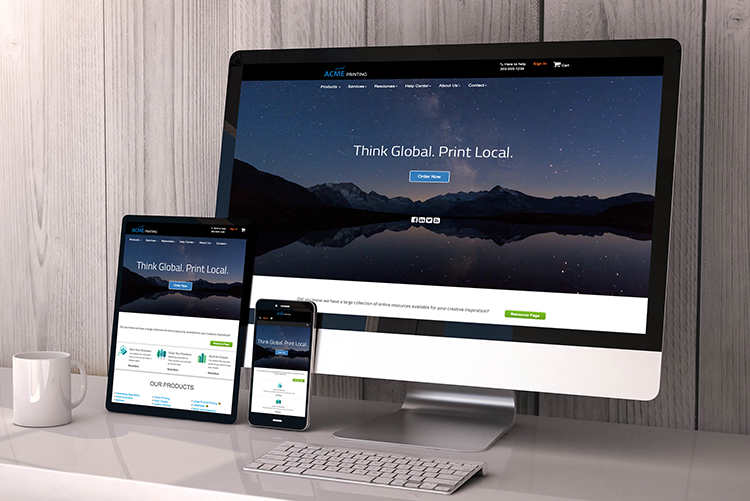
Every business needs a website, but have you ever stopped to think about why? Or stopped to evaluate if your print website is as effective as it could be? Having a website creates “…a window through which your business says hello to the world,” says blogger Amit Kalantri. And it’s true, especially when you consider that: Nearly 90% of people use the internet to find small businesses (yes, even print businesses), 84% of people think a website makes a business more credible, and 30% of consumers won’t even consider a business if they don’t have a website. (Ouch.) So, the question becomes, if the internet is where your print buyers are searching for you, are they finding you there, and are they satisfied with what they find? 5 Reasons Your Print Business Needs a Website If you’re still thinking that what you’re doing has worked up until this point, so why change, you might want to review these reasons for why a website should be the cornerstone of your print business. 1. A Print Website Paints a Picture of Who You are as a Business As a printer, you know how important it is for a person to have a business
The MI4P Process
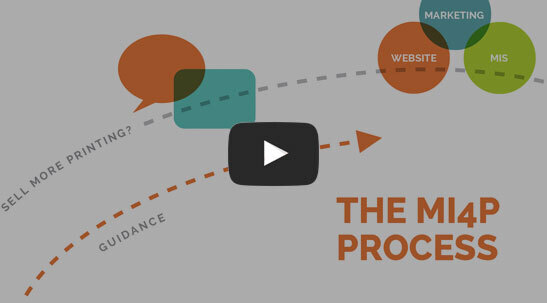
This two-minute video will show you how we take you through Our Proven Process. No surprises; no bumps in the road!
It's worked for hundreds of printers just like you; it will work for you, too! Download the MI4P Proven Process PDF below, and follow along.
PDF: The MI4P ProcessSay Hello
"*" indicates required fields
Who We Are
What We Do
Marketing Ideas For Printers
5990 14th Street South
Fargo, ND 58104
(701) 241-9204 (800) 736-0688
© 2026 Marketing Ideas For Printers
Our Privacy Policy | Terms of Service