Pricing Myths Printers Still Believe (And What Actually Works)

If you’ve ever debated whether to list your prices online or worried that you’ll lose business if you do, you’re in familiar territory. For many printers, pricing feels like walking a tightrope: charge too much and scare people off, charge too little and eat into your margins. It can feel like putting your worth on trial, especially when you’re competing with “race-to-the-bottom” online competitors. But it’s not just what you charge. It’s how you present your pricing that makes the difference. And chances are, some of the “rules” you’ve been following are doing more harm than good. Let’s bust a few myths that might be costing you sales and show you what you can do instead. Myth #1: If I Show My Prices, I’ll Scare My Print Buyers Away The idea that showing your prices drives prospects away is one of the most persistent myths in the print industry. It’s rooted in the fear that you’ll be judged solely on cost, that your higher prices will send your prospective print buyers running to online discounters. But in reality, hiding your prices creates an even bigger problem: distrust. Today’s buyers expect transparency. When they can’t find what something costs, they assume
3 Tools That Will Make Your Print Buyers Never Want to Leave

For any print business to succeed, you need customers! And, in times like we’ve all just experienced in 2020, you need customers for life that will weather whatever political candidates, pandemics, or other challenges may come, and who still stick it out and choose to do business with you. How can you be sure to make your printing business “sticky” enough to propel your business forward? It starts by laying the right foundation. The Foundation of Customer Retention Take a moment to consider a business you’re fiercely loyal to and think about why that is. If you’re like most of the other billions of consumers in the world, you’ll probably land around two things: customer service and ease of use. If you order your groceries online from your grocery store, for example, your purchase history, payment options, and saved items are all stored there for you. And, switching grocery stores would mean that you’d lose all that valuable information and would have to start over. (That sounds like work, doesn’t it?) Now, consider that same line of thinking from your print buyers’ point of view. What would a printer (yes, you) need to provide for it to be too much work
Why Printers Should Stop Editing PDFs in Adobe Illustrator
You’ve probably heard the expression, “Just because you can do something doesn’t mean you should.” For example: You can put a water hose in your car’s gas tank, but you probably shouldn’t. You can use the same password for all of your internet accounts, but you probably shouldn’t. You can use Adobe Illustrator to edit PDF files, but you probably shouldn’t. “Yep, uh-huh, wait… what? Why shouldn’t I use Adobe Illustrator to edit our PDF files?” Why Adobe Illustrator isn’t an Ideal PDF Editor Not too long ago, an update was applied to the engine that powers uDesignIt!, an MI4P website add-on that allows print buyers to personalize documents on printers’ websites. The update came with all the “normal” update stuff you’d expect, such as better performance, enhancements, etc. It also took care of some housekeeping items on the way PDFs are produced. The only downside of the update is that it caused the PDFs that are created as a result of using uDesignIt! to be less friendly when edited in Adobe Illustrator. The Real Question (And Answer) If you’re asking: “Less friendly? Does this mean I can’t use Adobe Illustrator to edit PDFs created by uDesignIT! any longer?”, the
Increased Customer Retention For Printers Starts Here
Customer retention is the foundation of any business, including yours. If you want your print business to thrive, it’s essential that you have the tools available to your customers to easily order from you again and again. As the late American engineer, statistician, and business consultant William Edwards Deming once said, “Profit in business comes from repeat customers, customers that boast about your product or service, and that bring friends with them.” Are your print buyers boasting about ordering online with your company? If not, it’s time to consider tools that will propel you forward on your quest to instantly boost your customer retention. Laying the Foundation for Retention For printers, customer retention starts by finding ways to make yourself “sticky.” For your print buyers, sticky means they have: An easily accessible order history A no-fuss way to quickly reorder what they’re looking for Reduced decision making, not having to know all of the details because you (the printer) already have them stored with each product for reordering Here are three tools available to you that will help you create just the kind of “stickiness” you’re looking for. Check out the webinar below! Want more great tips like this? Sign up
An Auto-Fill Improvement for uDesignIt!
We have a small, yet powerful update for printers using uDesignIt! on Websites For Printers websites. Your customers can now have their physical address information auto-fill the form for document personalization. Business cards provide the perfect case study. Up to this point with uDesignIt!, the website has used your customer’s account information (name, phone number, email address, etc.) to pre-populate information in the document being personalized. A pre-populated order form with a preview of the finished document looks something like this: But, notice there’s something missing: the address information. The difficulty comes when your customer’s account contains multiple addresses. For example, they may have a work address and a home address associated with their account. Which address information should the website use to pre-populate the order form? Now, your customer can decide! Here’s what happens: If there’s only one address in the customer’s account, it’s pretty straightforward; the website uses that address. However, if there are multiple addresses associated with the customer’s account, the website will default to the last address used and allow the customer to select a different address. Here’s a short 30-second video that shows how it all comes together. It’s ridiculously simple for your customers to use, and the best part is, it’s
The MI4P Process
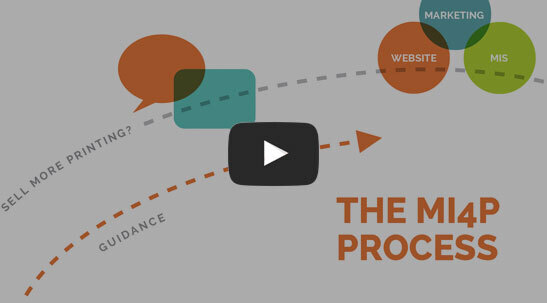
This two-minute video will show you how we take you through Our Proven Process. No surprises; no bumps in the road!
It's worked for hundreds of printers just like you; it will work for you, too! Download the MI4P Proven Process PDF below, and follow along.
PDF: The MI4P ProcessSay Hello
"*" indicates required fields
Who We Are
What We Do
Marketing Ideas For Printers
5990 14th Street South
Fargo, ND 58104
(701) 241-9204 (800) 736-0688
© 2026 Marketing Ideas For Printers
Our Privacy Policy | Terms of Service