Two Words that Could Change Your 2021

The new year brings with it a chance to start again. It’s a time to let go of the previous year and look forward to a fresh start. For me, cleaning and organizing are an annual goal of mine at the beginning of each year. Sometimes the goal is obvious to others (and they can tell the OCD fairy has arrived); other times, not so much. Uncovering a Print Treasure This year in my organizing, I uncovered something that my dad had produced for a customer roughly 35 or 40 years ago. My dad had liked the end product so much he produced a bunch more to use himself. What was it? A simple, classic thank you note. Produced on an 80# Classic Laid Baronial Ivory Cover, this type of printing project was a staple in most shops in the ’80s, especially for raised letter business cards. To produce this modest note, we used a Heidelberg Windmill press, and a blind embossing technique using a brass die with a counter die. Back then, we didn’t have the luxury of a heated platen, so we used dry gum built up in layers to make the counter die. It was softer and
5+ Challenges for 2021 that Will Help You Sell More Printing

A new year brings fresh hope for change, and with it, the excitement needed to take on a new challenge. In the past few years, challenges have been all the rage. A quick search online and you’ll find challenges for all sorts of things, such as fitness challenges, financial challenges, skills challenges, and more. So, doesn’t it seem like there should be a challenge for printers? Absolutely. Below are 5+ challenges to help you better your business in the coming year and sell more printing. Ready to make 2021 your best year yet? 1. Conduct a Business Assessment First things first, you have to know where to start. How is your print company doing at meeting the needs and opportunities of your print buyers? How about your internal team? What are their struggles and opportunities? Take the time to write some of these things down on paper. Determine the things you have that are working well, not so well, and those solutions you need to implement to wholly meet your buyers’ and your team’s needs. 2. Think Bigger Thomas Edison once said, “There’s a way to do it better – find it.” While it’s tempting to remain daily “in” the business,
Spread the Love Through All New Content for Your Printing Firm
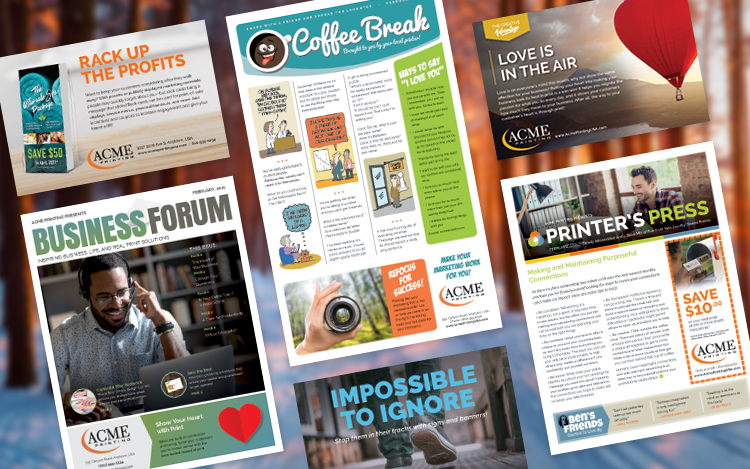
Bless your heart! February’s content is filled with heart-filled articles ready for you to spread to your magnificent customers. Created with love to help you grow your business, every package below is a superb option to save you time and effort in attracting customers and contracts. National Direct Mail Go big this month and show your customers the benefits of living larger than life with posters and banners. Large size prints are perfect for spring marketing campaigns, and the February issue of National Direct Mail puts the power of large print on display. National Direct Mail can get your printing firm’s name in the hands of potential buyers across the entire country with no zip code restrictions and included direct mail and social media marketing. This versatile mailer is poised to capture a wider audience and help you expand your market. The sky’s the limit. Printer’s Press This compact newsletter is designed to grab your customers’ attention! With print ideas, customer care articles, and a little light-hearted fun thrown in (such as trivia and “Can You Guess the Year?”), the Printer’s Press newsletter is the perfect combination to stay in touch with your buyers. Get February’s Printer’s Press package today,
How You Can Find the Missing Piece Through Perspective

Objects in mirror are closer than they appear… I remember staring out the car window at that message a lot when I was a child. I couldn’t understand how something could possibly look closer to me than it actually was. I considered myself a logical person, so something was either there or it wasn’t right? Was the object closer to me if I turned my head and looked at it without using the mirror? Of course not; I was missing the main point, “appear.” It wasn’t until I was an adult, and I revisited my childhood memories that I realized that things never really changed sizes. Instead, it just “appeared” that way based on the perspective of looking at things in the mirror. I also discovered, as a result of adulthood, that I can be pretty closed-minded at times and lack perspective in other areas of my life. The Perspective Puzzle During the COVID-19 lockdown back in April, my wife and I spent a lot of time working on jigsaw puzzles. Our process looked something like this: First, we would finish the border, then we would work our way to the center from the outside. We each had our “regular”
3 Lessons I Learned from Brain Surgery that Could Benefit Your Print Business

Man, that’s a blog title I never thought I’d write. But sure enough, here I am on the other side of an incredible life valley with a better understanding of what the late Philip Roth once said, “Nothing bad can happen to a writer. Everything is material.” In early May of this year, I was diagnosed with a rare, chronic neurological pain condition called trigeminal neuralgia. At the beginning of August, I underwent a successful microvascular decompression brain surgery. While spending six weeks in recovery, I was able to sit, to think, and to see things differently than the go-go-go of my normal, everyday life. I quickly came to the realization that there are easy things in life, and there are hard things, but ALL things can teach us something if we’re open to it. So, if you currently find yourself in a tough spot (as so many have in 2020), here are three of the lessons I learned that could help your print business weather any current or future storm. 1. There’s Always a Choice Did your print business have to shut down during the pandemic and you’re still struggling to recoup lost print sales? This pandemic has truly been
A Little Reflection Goes a Long Way: 6 Questions to Ask Yourself

While some of us may feel like we’re on the backside of the v*rus shutdown, many of us may still be in the throes of the turmoil, wondering how we are going to make it. If you’re still wondering, “What in the world is going on here?!!”, let me assure you that you are not alone. Wherever you may find yourself, it’s always a good time to pause, reflect, and learn from the events happening in our world. A great way to do that is by taking some time out of your crazy days to ask yourself some important questions. Here are a few questions I have been asking myself lately. Some may sound fatalistic, but I choose to ask them with the intent of uncovering the opportunities within the answers. What have I learned to live without? How have my customers’ requirements changed? Are their needs smaller, different, temporary, or gone away for good? What is the best thing I have done in the past three months that has lessened any damaging impact for both my customers and my team? What is the worst thing I have done that has made it worse than it was? Is my team
Moving Upstream to Solve Problems

What would you do if you saw a young child drowning? Consider this story: You and a friend are having a picnic by the side of a river. Suddenly you hear a shout from the direction of the water—a child is drowning. Without thinking, you both dive in, grab the child, and swim to shore. Before you can recover, you hear another child cry for help. You and your friend jump back in the river to rescue her as well. Then another struggling child drifts into sight…and another…and another. The two of you can barely keep up. Suddenly, you see your friend wading out of the water, seeming to leave you alone. “Where are you going?” you demand. Your friend answers, “I’m going upstream to tackle the guy who’s throwing all these kids into the water.” That story is a public health parable (adapted from the original, which is commonly attributed to Irving Zola), and provides the starting point for Dan Heath’s book, Upstream: The Quest to Solve Problems Before They Happen. We’ve all been there, right? The daily fires and emergencies demand attention. They’re all we see. But sometimes these problems are just blinding distractions that keep us from seeing
An Easy Trick to Hit Your Sales Goals

The impact of COVID-19 has hit the sales efforts of many hard. Every successful salesperson likes to keep score. And there’s nothing quite as deflating as a scorecard that shows you’re not winning. It doesn’t have to be that way, though. Here’s an easy trick on how you can keep score to make sure your sales goals hit the mark 100% of the time. An Unexpected Method: Easy as 1-2-3 Instead of focusing on one area, broaden your viewpoint. This score-keeping method is based on keeping the score for three different sales targets: Must, Should, and Could. Set your expectations for these sales targets by answering these three questions prior to each sales call: What must happen for this part of the sales process to be considered a success? What should happen if I do what must be done? What could happen if I do what must be done? Step 1: Must The “Must” target is the foundation for your scorecard. It should represent one single activity that’s completely within your control that must occur for this sales effort to be considered a “win” on the sales scorecard. An example would be “Call prospect for an appointment.” If you made an effort to place
The One Thing I Wouldn’t Want to Be Without

I was asked the other day what my most valuable asset was. A question like that definitely makes one think long and hard. What is the one thing that you would not want to be without? After some pondering (no, pondering doesn’t do a question like this justice), after some soul searching, I came to the conclusion that if I woke with nothing left except my family and health, the one thing I would want above anything else is: Integrity. Who are You When No One is Looking? Integrity, in my definition, is much more than a person’s reputation. Reputation is like paint on a house. It can look pretty, or it can look ugly, but it’s what’s underneath that matters. It’s the very structure holding everything else up that makes the difference. Without that structure in place, a strong wind, such as we’ve been experiencing lately, can blow the whole thing down. Integrity gets a person up in the morning to go and provide for their family and employees. It ensures that our customers, vendors, and all other parties to our business are taken care of. Here are a few more examples of what integrity is: Integrity is more
Think You Can’t Network Because of COVID-19? Think Again.

It seems like it’s been a year since I was in a room with more than ten people. More recently, I’m hearing this a lot: “We’ve ramped up our direct mail and digital marketing to reach our market, but I really miss interacting with people. I’m ready to start “networking” again!” The word “networking” used to be confusing to me. I thought that in order to be networking actively, you had to be at a networking event. But over the years, I’ve learned that actual events have very little to do with effective networking and, therefore, the limitations put on us to reduce the spread of the COVID-19 virus also have very little to do with effective networking. What is Networking? Merriam-Webster defines networking as: The exchange of information or services among individuals, groups, or institutions specifically : the cultivation of productive relationships for employment or business I really want us to focus on the last part: “The cultivation of productive relationships.” In a nutshell, that’s all networking is! Someone, somewhere along the way, realized that if we put a bunch of people in a room who were interested in “cultivating productive relationships,” it would remove some of the obstacles
The MI4P Process
This two-minute video will show you how we take you through Our Proven Process. No surprises; no bumps in the road!
It's worked for hundreds of printers just like you; it will work for you, too! Download the MI4P Proven Process PDF below, and follow along.
PDF: The MI4P ProcessSay Hello
"*" indicates required fields
Who We Are
What We Do
Marketing Ideas For Printers
5990 14th Street South
Fargo, ND 58104
(701) 241-9204 (800) 736-0688
© 2026 Marketing Ideas For Printers
Our Privacy Policy | Terms of Service