10 Ways to Become a Better Leader at Your Printing Business

Running a printing business is no easy task, and one of the most critical factors that can make or break your success is effective leadership. Strong leadership plays a pivotal role in steering your print company towards growth. It’s not just about managing the day-to-day operations; it’s about inspiring and guiding your team to reach their full potential and drive the business forward. What’s the Big Deal About Print Leadership? A great leader sets the tone for the entire organization, print or otherwise. Your vision, passion, and commitment can be contagious, motivating your team to share your drive and dedication. By fostering a positive and creative work environment, you encourage your employees to think innovatively, leading to improved solutions and a competitive edge in the market. Solid leadership also directly impacts customer experience. When your team is inspired and focused on delivering excellence, it reflects in the quality of your services. Satisfied customers become loyal supporters and brand advocates, amplifying your business through word-of-mouth referrals. Strong leaders are also adaptable and resilient. They embrace new technologies, staying ahead of the curve and remaining competitive. The truth is, as a printing business leader, your actions and decisions influence the success and
More Than a Printer: More Than Ink Printing, Jacksonville, FL
Iconic printer Benjamin Franklin once said, “Without continual growth and progress, such words as improvement, achievement, and success have no meaning.” Continual business growth is something that’s always expected but never really explained. How do you grow? When is the right time to take those bold next steps? These are questions that More Than Ink Printing in Jacksonville, Florida, has contemplated and recently answered. Introducing More Than Ink Printing In 2005, More Than Ink Printing began as a small newspaper print company. As the years went by, the company grew steadily and became a well-known local print shop. Today, the company employs roughly thirty people and is run by President and Co-Owner John Christiansen and Vice President and Co-Owner Aaron Canaday. Together, they’ve put their long history in the print industry to work and expanded the business. In 2017, the company’s focus shifted towards newer technology and becoming the leading printer in the area. “We’ve been growing steadily ever since, adding new people nonstop and doing all sorts of new things along the way,” explains Aaron Canaday. “One of those things has been building a larger facility, which is one more step in getting us to that next level we’re
Dear Print Owner, 5 Tips for Changing Your Perspective

If you’re a word nerd like me, you already know the trick to getting unstuck in any word game – you change your perspective. From rearranging the letters to spinning the board around to silently asking things like, “Is paczki* a word?”, you do whatever it takes to get your brain to engage in a different way. *(Paczki is a word, by the way, a 23-pointer!) If you’ve been feeling stuck in your ways and are looking for a fresh perspective to boost your print business, you’ve come to the right place! Here are a few tips on changing your perspective and taking your printing company to the next level. Start with why. First things first, ask yourself why changing your perspective is important. As the old saying goes, “If you always do what you’ve always done, you’ll always get what you’ve always got.” In other words, if you want to see real growth and success in your printing business, you need to be willing to try new things and think outside the box. So, how do you go about changing your perspective? Here are a few tips: Look at your business from your print buyer’s perspective. It’s easy to
8 Post NPSOA Conference Strategies to Implement Right Now

Printers from across the nation gathered in Myrtle Beach, South Carolina, this past weekend for the National Print and Sign Owners Association conference. What an incredible time of learning, connecting, and growing the future of the print industry! While events like these often leave you energized, all of your intentions can easily fall to the wayside when you find yourself back in the midst of the daily grind. That means there’s no time like the present to put your newly acquired knowledge into practice. Maximize your post-conference momentum with our top eight strategies! 1. Reflect on key takeaways Dedicate time to mentally process the information, insights, and experiences gathered at the conference. Make a list of the most important lessons learned, ideas that resonated with you, and trends that could impact your work or industry. Mapping out key takeaways will help you create a follow-up action plan. 2. Organize and review conference materials Sort through any pamphlets, business cards, and promotional materials collected during the conference. Review them carefully to ensure that no crucial information is overlooked and to refresh your memory on essential topics. 3. Restructure your personal notes Since notetaking during conferences can be somewhat scattered, it’s important to
NPSOA for Printers: 10 Tips to Maximize Your Time Away

Don’t miss the opportunity to join us at the 11th Annual NPSOA Owners Conference in Myrtle Beach, South Carolina. Held from March 16-18th, this annual event is always one of the highlights of our year. We look forward to seeing and connecting with you there! It can be challenging to step away from the daily operations of your business, but it’s essential for your success. To get the most significant benefit from your time out of the office, you need to set goals and plan to make the most of this break. After all, if you’re investing money to attend a trade show, don’t you want to get something in return? Get the Most Out of Your Visit to NPSOA Conference with These 10 Tips! To ensure your hard-earned money and time are used efficiently, here are ten strategies to capitalize on this event and attain optimal returns. 1. Do Your Homework Before attending a trade show, you must do your homework to understand all available opportunities. To ensure you are adequately prepared for success, arm yourself with the necessary knowledge and resources to help you reach your goals. Here’s a list of items worth researching before getting started: The
Communicating with Your Customers: An Easy Way to Build Trust and Credibility

Every business owner knows that customer service is critical to staying competitive. But what about communicating expectations? Do you ensure your print buyers know what to expect when doing business with you? Recently, I received an email in response to an order placed by someone in our organization. It impressed me so much that I printed it out and shared it with the team. The message was short but concisely expressed precisely what the customer (me, in this case) could expect in their journey. This got me thinking—how often do we communicate these expectations with our own customers? This email response above created anticipation for the next interaction. It made me want to follow their guidelines even though they weren’t even stated. It eased my mind, knowing that there wasn’t going to be any guessing. Even more important, it makes me want to do that for my customers. It’s simple and didn’t cost a dime. The Benefits of Setting Print Buyer Expectations Upfront Setting expectations upfront is a great way to create trust and credibility with your print buyers. It gives them an idea of how your business operates and helps set up the foundation for a successful relationship between
10 Ways to Keep the Holiday Cheer Alive at Your Print Shop All Year Long

The holidays seem to come and go in the blink of an eye. One moment we’re decking the halls, and the next, we’re already planning for New Year’s. But what happens when all that holiday cheer disappears? Here are ten ways to keep your print shop’s spirit merry and bright 365 days a year! 1. Create a Festive Theme Creating a festive theme in your store that corresponds with the current holiday is an excellent way to show your customers you care while also adding some fun for your employees. Whatever the holiday may be, make sure your decorations reflect it. Giving away small items related to the occasion is also a kind–and appreciated–gesture. Customers will love getting free candy, gift cards, or even colorful pens and notepads — it makes a great visit to your print shop even better. 2. Host Monthly Events Show your appreciation to your print buyers by hosting monthly events throughout the year. A few ideas to consider are: Customer appreciation days where you offer discounts on products or services Open houses where customers can meet staff and view recent work Holiday-themed parties where everyone can have some fun Not only will these events boost
The Future Looks Bright for Selling More Printing

If we were like every other business, we’d be offering you a year-end review right about now. But, you know what? Here at Marketing Ideas For Printers, we like to do things a little differently to allow for a greater vision. It looks like this. We follow a quarterly rhythm for working on the bigger projects that bring content and online ordering solutions together by asking ourselves, “What are the most important things we need to accomplish in the next 90 days?” We then create that list and get to work on those most important projects. Often, one of the first things I do when starting a project like that is to write a press release announcing the completed project. That press release is used for vision casting and for internal use only; its purpose is to help everyone involved understand what the project’s end result is supposed to look like. That, in turn, helps everyone get pointed in the right direction immediately. In the spirit of those “predictive press releases,” I thought you’d enjoy my perspective on the coming year here at Marketing Ideas For Printers and what’s coming your way to help you sell more printing. 2023: A
Giving Thanks for the Print Industry: What Printers are Saying
Blessings. Joy. Thankfulness. Gratitude. These are the words of the season. They are also the words from many print owners who have dedicated their careers, their lives to this industry. As you take time to count your blessings this week, don’t forget the incredible joy that can be found through print. Giving Thanks for the Print Industry We asked several printers what they’re most thankful for about being a part of the print industry. Here’s what they had to say. Tri M Graphics “I am thankful to be in the Print Industry because we can make a difference. We have the opportunity to partner with our clients to help them achieve results. Communication is such a vital part of what we do; through our printed material, we can help to build and/or strengthen relationships. Printing can be so much more than a transaction if you open your mind up to the possibilities.” – Michael Jensen Tri M Graphics, Owatonna, Minnesota “I am thankful for the Printing Industry because we make the world more colorful! Imagine how boring everything would look with no printing!” – Derek Brooks Brandywine Printing, Cumming, Georgia “Although it can be a stressful, deadline-oriented business, I can’t think
Want to Be a Better Printer? Start by Dusting Off Your Tools

Every so often, I like to go through the drawers of my tool chest in the barn and take an inventory of things. I’m not talking about an extensive certified public accounting inventory, but just a look around to see what I already have that I might have forgotten existed. I’ll usually find multiples of things that I forgot I had or that I have never used but bought anyway because of my “I might need that someday” syndrome. A tool review accomplishes a couple of things: First, it keeps me on track when I wander into retail la-la land at the home improvement store. Secondly, it reminds me of things I know needed fixing or mending that have been waiting around until I found the perfect tool for finally getting a “round tuit.” A Tool Review of Your Print Business I apply this tool review concept in my print business as well. From digital tools to hardware to equipment, I like to run everything through a series of questions: What do I have that I am not using? What can I use it for? Am I ever going to use it? What was I going to use it for
The MI4P Process
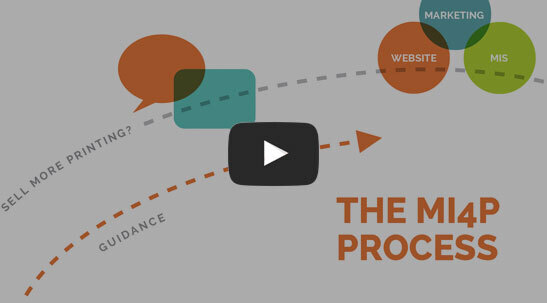
This two-minute video will show you how we take you through Our Proven Process. No surprises; no bumps in the road!
It's worked for hundreds of printers just like you; it will work for you, too! Download the MI4P Proven Process PDF below, and follow along.
PDF: The MI4P ProcessSay Hello
"*" indicates required fields
Who We Are
What We Do
Marketing Ideas For Printers
5990 14th Street South
Fargo, ND 58104
(701) 241-9204 (800) 736-0688
© 2026 Marketing Ideas For Printers
Our Privacy Policy | Terms of Service