AI for Business Growth: Seeing the Opportunities Hiding in Plain Sight: Part 6 of The AI Success Journey for Printers

From efficiency to opportunity Over the past five months, we’ve seen Clay take AI from theory to practice, and then from practice to habit. He’s tested simple use cases, built confidence, and brought his team along for the ride. Now, those small wins are becoming systems. What started as one-off experiments is turning into workflows that support real momentum. This month, something shifts again. Clay stops asking, “How can we work more efficiently?” and starts asking, “Where could we grow?” That’s when AI moves from operational support to strategic guidance. A rare lull and a curious question It was a Wednesday morning that felt… strange. No fires to put out. No rush jobs dropped in at the last minute. The front desk was calm. The install team was out early. Even the pressroom, usually alive with noise and motion, had settled into a quiet rhythm. Clay poured a second cup of coffee and did something rare: he stood still. We’ve got capacity today, he thought. Not just in production, but in attention. Mental space. Breathing room. It wasn’t a luxury he was used to. And he didn’t want to waste it. He walked back to his office and opened a tab he
AI for Production and Workflow Efficiency: Part 5 of The AI Success Journey for Printers
From curiosity to integration Over the past few months, we’ve watched Clay’s journey with AI move from curiosity to capability. He’s tested simple use cases, built confidence, and brought his team along for the ride. Now, those small wins are becoming systems. What started as one-off experiments is turning into workflows that support real momentum. In this chapter of the journey, Clay sees how AI can reduce friction in production, quietly improving the rhythm of the workday. “If we had five more minutes…” It was a passing comment. Rick probably didn’t even mean anything by it. They were walking through the back after a morning install update when he said it: “If we had five more minutes every day, we’d be ahead instead of behind.” Clay nodded. He’d heard versions of that phrase before. The details changed—different job, different delay—but the feeling was always the same: there’s just not enough time to get ahead. That afternoon, Clay sat in his office, staring at next week’s production list. Same mix of projects. Same order flow. Same tight window. We’re not short on people, he thought. We’re short on space: in our day, in our process, in our heads. He opened his laptop, and for
You’re Not Getting Replaced, You’re Getting Ready: Part 4 of The AI Success Journey for Printers
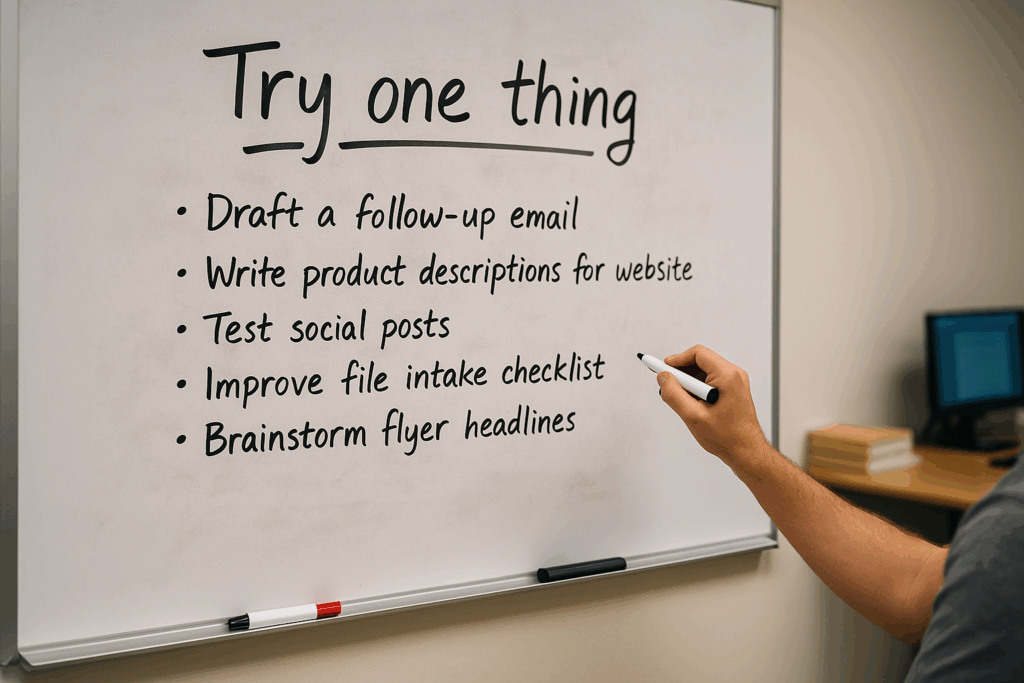
From Curiosity to Conversation If you’ve been following Clay’s story for the last few months, you’ve seen how his first experiment with AI gave him something every print shop owner needs—confidence. But confidence isn’t enough. If a business is going to grow, change has to become a conversation. This month, in part 4 of The AI Success Journey for Printers, Clay starts talking with his team about AI… and finds out what they’re really thinking. “Let’s Talk About AI” Monday morning at Riverbend Print & Sign started like any other: coffee, install updates, a quick recap of orders going to production… but then Clay did something new. “Before we wrap up this meeting, there’s one more thing I want to talk about,” he said. “Let’s spend a few minutes on AI.” The room shifted. Jess glanced at Rick. Rick looked down at his notes. Someone exhaled a little too loudly. Maybe this was a mistake, Clay thought. They’re already picturing robots in the breakroom. But he kept going. Calm. Measured. “Last week, I used a free AI tool to help write a follow-up email to a customer who hadn’t responded. That one message turned into something I’m now doing regularly—a simple
What AI Can (and Can’t) Do for Print Shops: Part 3 of the AI Success Journey For Printers
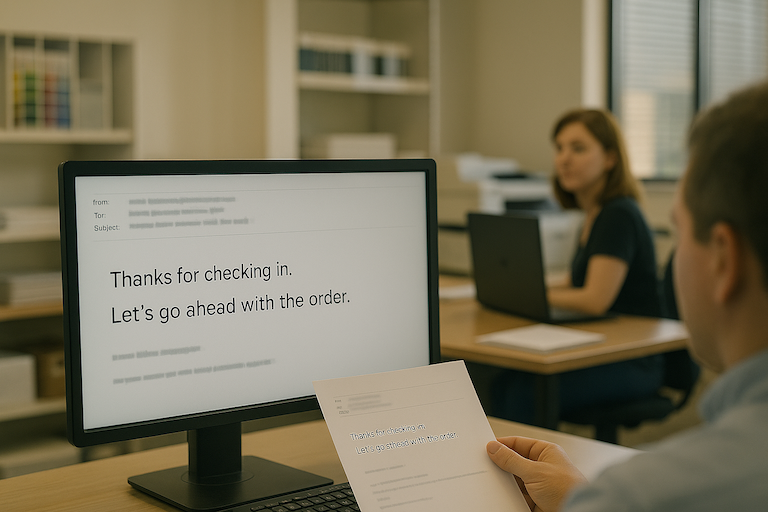
Start small. Start safe. See what happens. Clay’s not diving into the deep end. He’s not trying to overhaul his whole business. He’s just doing what I recommend every printer do when they’re curious about AI: start small, start safe, and see what happens. Let’s continue with Part 3 of Clay’s story. A blank screen and a blinking cursor It was a quiet Saturday morning at Clay Morgan’s house. The shop was closed. His wife was out running errands. And Clay was sitting at the kitchen table, laptop open, coffee in hand. He stared at the prompt box on a free AI tool he’d bookmarked weeks ago. What am I even supposed to ask this thing? He thought about the customer who had gone silent after receiving a quote for two, 4’x8’ signs. Nothing unusual. But still, it bothered him. Okay, let’s keep it simple, he muttered, and typed: “Write a follow-up email to a customer who hasn’t responded in two weeks.” The tool responded almost instantly with a perfectly formatted email. Dear Valued Customer, We hope this message finds you well… Clay squinted at the screen. I’d never send that. It was professional, sure. But it didn’t sound like him.
When “Fine” Starts to Feel Like Falling Behind: Part 2 of the AI Success Journey For Printers

When I shared Clay’s story last month, I described him as fictional but built from real conversations with printers just like you. That’s still true. Clay’s not here to tell you what to do. He’s here to help you see what’s possible. And I’m here to walk with you as you figure out what your own AI journey might look like at your own pace, one step at a time. This month, we check in on Clay as something begins to shift. His shop is steady. His people are solid. But deep down, he’s wondering: What happened to the spark? Same Shop, Different Feeling Monday morning at Riverbend Print & Sign looked exactly the same as it had for years. Clay Morgan walked into his main location at 7:58 a.m., coffee in hand, phone already buzzing. Jess from the front desk gave him a quick update on the delayed install at McKenzie Automotive. Production had run into a material issue, but the customer was still “fine with it.” Over at the cutter, his lead tech asked about reprinting a seasonal banner they’d done last year. “Check the archive, it’s probably there,” Clay said, half-turned toward his screen. It was all normal.
The AI Wake-Up Call: Part 1 of the AI Success Journey For Printers
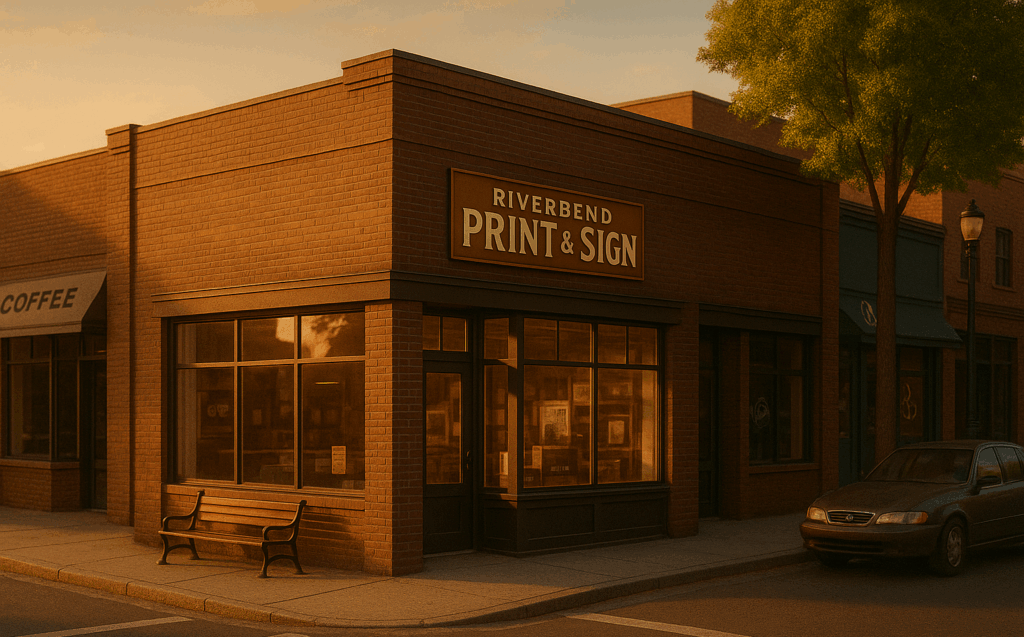
AI Didn’t Just Change My Mind, It Refocused My Mission When I first got serious about exploring AI, I looked at it through the lens I knew best: marketing. How could it help us produce better, more effective content for printers? That seemed like the right-sized question to ask. But I quickly discovered I was thinking too small. What started as a marketing experiment became something much more. The deeper I went, the more I realized that AI wasn’t just another content tool, it was a business tool. One that could reshape operations, communication, decision-making, hiring, forecasting. I wasn’t looking for a shift in my professional identity, but I found myself re-energized by what I was learning. AI didn’t overwhelm or distract me; AI refocused me. That shift didn’t move me away from the work I’ve always done with printers. It brought me closer to it with more precision and sharper alignment with our mission: to help printers sell more printing. The industry I care about is entering a new chapter, and I want to help printers step into it with clarity, confidence, and control. Which brings me to someone I’d like you to meet. Meet Clay Morgan Clay Morgan
Stop Treating AI Like Google (and Start Using It Like Your Assistant Coach)

How smart printers are getting better results by leading the conversation, not just asking for answers. If you’re like most print shop owners I talk to, you’ve probably dabbled with AI by now. Maybe you’ve even typed something like: “Write me a follow-up email for a customer who hasn’t responded.” And what came back was… fine. Not great. Not personal. Definitely not the kind of thing that makes you think, “Wow, this sounds just like me!” If that’s been your experience, here’s the good news: It’s not your fault. You’re just using the wrong playbook. You Don’t Win the Game By Reading the Playbook Alone If you’ve ever watched a high school football game—or better yet, had a kid on the team—you know the coach doesn’t just hand out a fat binder of plays and yell, “Good luck out there!” (At least, we hope not.) The real value of a good coach is in the conversation that happens before the play gets called: “What’s the defense showing you?” “What’s working today that didn’t work last game?” “How do we adjust so you don’t get flattened again on third down?” AI works the same way. Most people are using it like Google—asking for quick,
Small Orders, Big Decisions: A Brighter Future

In last month’s article, Sam Lewis began transforming Print Perfect’s operations to better handle the influx of larger projects. Now, he reflects on how far his business has come—from struggling with low-margin jobs to thriving with a balanced, efficient workflow. As Sam looks ahead, he considers new ways to strengthen his team and grow his business sustainably. In this final installment, we see the culmination of Sam’s journey and the lessons that have set him up for a brighter future. Part 6: Small Orders, Big Decisions: A Brighter Future As Sam closed up shop one evening, he took a moment to reflect on how far Print Perfect had come. What had once been a simple print shop was now a thriving business capable of handling a range of jobs, from the smallest flyers to complex, high-volume orders. Implementing minimum charges, streamlining operations, and focusing on building deeper client relationships had all played a part in this transformation. But he knew the journey wasn’t over. The Path So Far Thinking back, Sam could hardly believe the challenges he and his team had tackled. From small, low-margin copy jobs to more efficient, large-scale projects, each step had required difficult decisions and careful
Small Orders, Big Decisions: Turning Small Jobs into Big Wins

Previously, Sam Lewis tackled the challenge of managing client expectations after implementing minimum charges at Print Perfect. With the policy now in place, Sam begins looking ahead to new opportunities. Instead of viewing small jobs as obstacles, he starts to see them as stepping stones for growth. This month, Sam explores ways to build deeper relationships and turn low-margin interactions into gateways for larger, more profitable projects. Can these small wins pave the way for big success? Part 4: Small Orders, Big Decisions: Turning Small Jobs into Big Wins Sam had spent weeks refining Print Perfect’s approach to minimum charges and client communication. But as he looked over his books, he noticed that while the small jobs had become more manageable, they still weren’t driving growth. “There has to be a way to turn these into something more,” he thought, pondering how to make low-margin work a stepping stone for bigger projects. Finding Value Beyond the Profit Margins One afternoon, Sam discussed his thoughts with Laura. “I’m wondering if we’re missing out on opportunities with some of these small jobs,” he began. “If we could turn these clients into repeat customers for larger projects, that could really make a difference.”
Small Orders, Big Decisions: Managing Client Expectations

In last month’s article, Sam Lewis began setting minimum charges for Print Perfect, a necessary but challenging step to sustain his business. Now, he faces an equally tough task: communicating these changes to his loyal clients. As concerns and questions arise, Sam learns that managing expectations is just as critical as implementing new policies. In this installment, we see how Sam navigates client conversations with transparency and tact, working to preserve trust while staying true to his business goals. Since implementing minimum charges, Sam had mixed feelings. Some clients understood and appreciated the change, but others raised concerns. Now, he faced the next challenge: how to communicate these changes in a way that would keep clients satisfied without undermining his business goals. One morning, as he prepared his usual cup of coffee, Laura approached him. “Sam, I think we need a consistent way to explain these new charges. We’ve been doing it one conversation at a time, and it’s a bit overwhelming.” Sam nodded, “You’re right. It’s time we establish a clear approach.” Building a Communication Strategy Sam decided to craft a message he could use across all client interactions. He drafted an email that outlined the reasons for the
The MI4P Process
This two-minute video will show you how we take you through Our Proven Process. No surprises; no bumps in the road!
It's worked for hundreds of printers just like you; it will work for you, too! Download the MI4P Proven Process PDF below, and follow along.
PDF: The MI4P ProcessSay Hello
"*" indicates required fields
Who We Are
What We Do
Marketing Ideas For Printers
5990 14th Street South
Fargo, ND 58104
(701) 241-9204 (800) 736-0688
© 2026 Marketing Ideas For Printers
Our Privacy Policy | Terms of Service