From curiosity to integration
Over the past few months, we’ve watched Clay’s journey with AI move from curiosity to capability. He’s tested simple use cases, built confidence, and brought his team along for the ride. Now, those small wins are becoming systems. What started as one-off experiments is turning into workflows that support real momentum.
In this chapter of the journey, Clay sees how AI can reduce friction in production, quietly improving the rhythm of the workday.
“If we had five more minutes…”
It was a passing comment. Rick probably didn’t even mean anything by it.
They were walking through the back after a morning install update when he said it:
“If we had five more minutes every day, we’d be ahead instead of behind.”
Clay nodded. He’d heard versions of that phrase before. The details changed—different job, different delay—but the feeling was always the same: there’s just not enough time to get ahead.
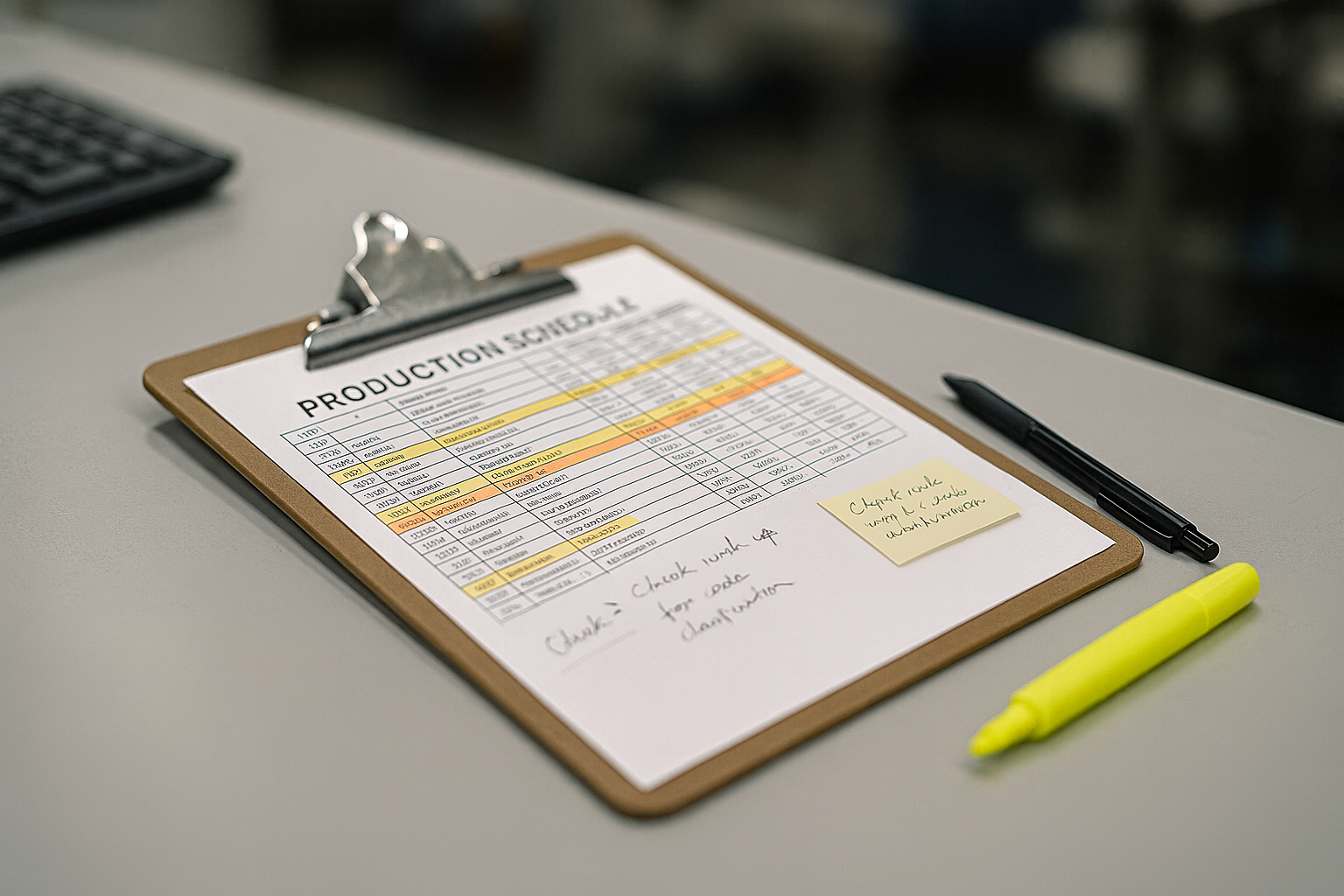
That afternoon, Clay sat in his office, staring at next week’s production list. Same mix of projects. Same order flow. Same tight window.
We’re not short on people, he thought. We’re short on space: in our day, in our process, in our heads.
He opened his laptop, and for the first time, he used AI for something other than communication.
A new kind of test
Clay pulled up the list of incoming jobs and started experimenting.
He typed:
“Summarize this list of production jobs by type, deadline, and prep time. Suggest a weekly schedule that balances staff and keeps Monday and Friday lighter.”
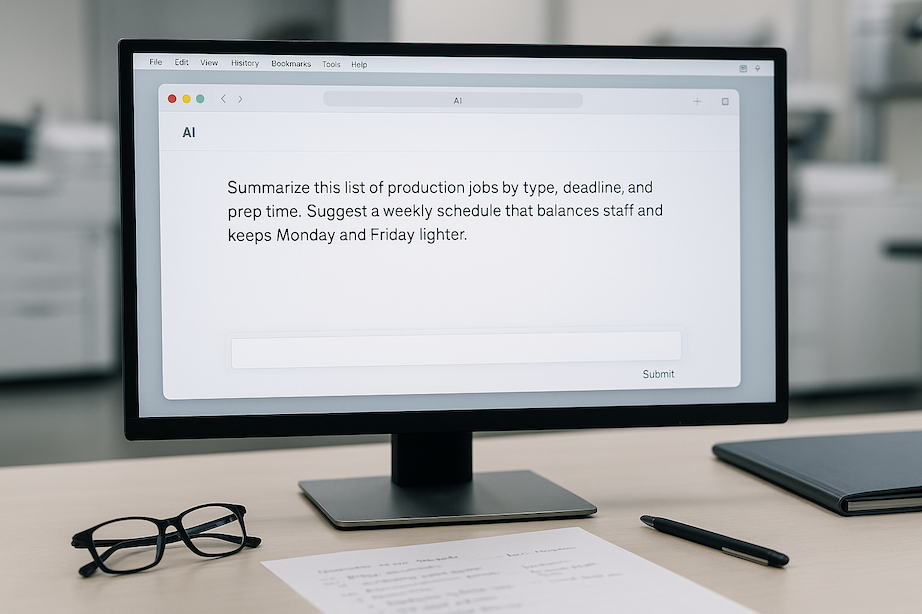
The AI gave him a quick outline. It wasn’t perfect. But it flagged a Friday delivery that needed to be prepped by Wednesday, and it pointed out that three jobs were pulling from the same material batch.
Okay, this isn’t magic, Clay thought. But it’s saving me the mental load.
He made a few tweaks, added notes for Rick, and printed out the schedule.
It looked good enough to test.
“Looks better than my sticky notes.”
The next morning, Clay handed the schedule to Rick before the morning huddle.
“AI helped sketch this out. Take a look. Let me know if anything looks off.”
Rick scanned it. Raised an eyebrow.
“Looks better than what I’ve been scribbling on sticky notes.”
Then, after a pause:
“You sure this thing knows how we work?”
Clay shrugged.
“Not yet. But we do. It’s just giving us a head start.”
Rick made a few edits. Crossed out one note. Added a delivery reminder. Then handed it back.
“Alright. Let’s post it.”
The quiet win
That week, production felt… smoother.
Fewer last-minute questions. Less confusion around prep timing. No forgotten materials.
Jess even noticed.
“Feels like Rick’s not yelling across the shop as much,” she said with a smile.
By Friday, Rick stopped Clay on the way out.
“This gave us a head start,” he said. “Didn’t expect that.”
Clay nodded, but didn’t say much. He was already thinking about what else might be possible.
That’s how real AI adoption usually happens—not with a big announcement, but with a small shift.
A one-time test becomes a repeatable process.
A task that felt heavy gets lighter.
A schedule that used to live in someone’s head starts living on paper, and works better for everyone.
Clay was moving beyond using AI just for quick wins. He was starting to create well-structured instructions for AI to do the repeatable work, step by step, to accomplish real business tasks. Clay’s involvement was reduced to providing occasional quality control checkpoints. Clay was now starting to create AI workflows.
And it worked.

Why this matters
Not everything needs to be automated. Not every process needs to be rebuilt.
But when AI gives you back even five minutes a day—five minutes of breathing room, five minutes of clarity—that’s a win.
And enough of those wins strung together?
That’s momentum.
Next month in the series
Clay shifts from internal processes to business growth—using AI to uncover new revenue opportunities hiding in plain sight.