AI Didn’t Just Change My Mind, It Refocused My Mission
When I first got serious about exploring AI, I looked at it through the lens I knew best: marketing. How could it help us produce better, more effective content for printers? That seemed like the right-sized question to ask.
But I quickly discovered I was thinking too small.
What started as a marketing experiment became something much more. The deeper I went, the more I realized that AI wasn’t just another content tool, it was a business tool. One that could reshape operations, communication, decision-making, hiring, forecasting.
I wasn’t looking for a shift in my professional identity, but I found myself re-energized by what I was learning.
AI didn’t overwhelm or distract me; AI refocused me.
That shift didn’t move me away from the work I’ve always done with printers. It brought me closer to it with more precision and sharper alignment with our mission: to help printers sell more printing.
The industry I care about is entering a new chapter, and I want to help printers step into it with clarity, confidence, and control.
Which brings me to someone I’d like you to meet.
Meet Clay Morgan
Clay Morgan is a fictional character, but his story is built from dozens of real conversations I’ve had with printers just like you. He’s a composite. A reflection of what so many print business owners are quietly working through right now.
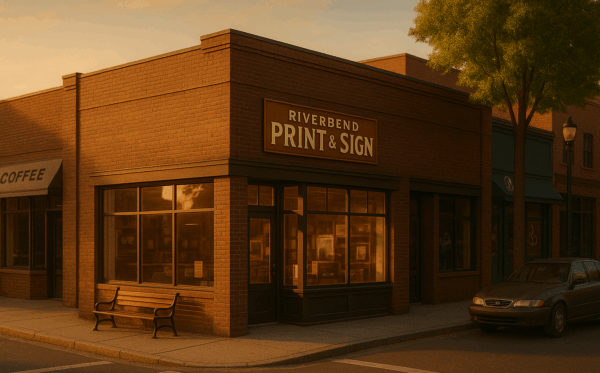
Clay owns Riverbend Print & Sign, a full-service print and signage company based in Baton Rouge. He started the business two decades ago with a single wide-format printer and a relentless drive to serve local businesses. Over time, Clay expanded into three locations with a team he trusts and a reputation for quality.
He’s proud of what he’s built, and he should be. The business is still profitable. Still strong.
But lately, Clay has felt something shift.
Not burnout. Not failure. Just a low-grade sense that the business isn’t moving forward the way it used to. Things still get done, but the energy is different. The spark isn’t quite there. The playbook that built his company doesn’t seem to be creating the same momentum anymore.
He’s not worried. He’s wondering.
A Story Begins
This isn’t a case study. It’s a narrative. A way to walk with Clay as he faces questions, makes small bets, tries, fails, and learns.
We’ll follow him through conversations with his team, experiments with new tools, and moments of doubt that give way to clarity. His story won’t be overly polished. It won’t pretend that change is easy. But it will be honest. And, I hope, helpful.
It starts on an ordinary evening after an unremarkable day. Clay had just wrapped up a full schedule—client calls, supply chain delays, and a follow-up meeting about a quoting error that nearly cost them a long-term customer.
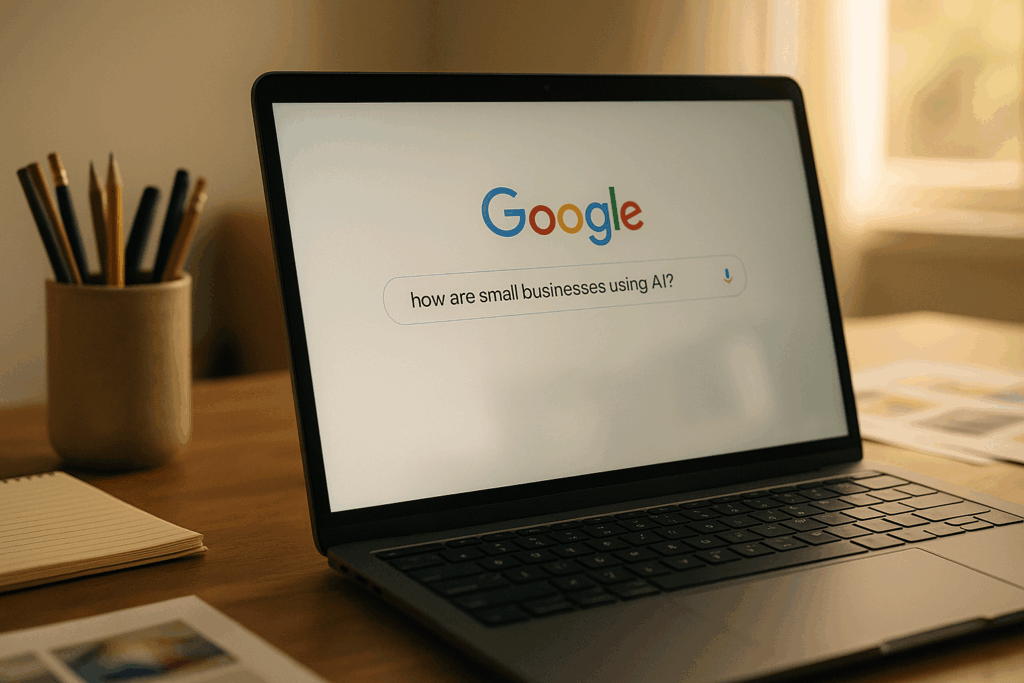
Back at home, tired but wired, he opened his laptop and searched: “How are small businesses using AI?”
The First Spark
He wasn’t exactly sure what he was looking for. This is probably a waste of time, he thought. Half this stuff is written for tech companies. Not sign shops.
The first few links felt like confirmation. Too abstract. Too theoretical. “Transformational synergy.” “Predictive leverage.” Whatever that meant. He was about to shut it down when one headline caught his eye: “How I Automated My Repeat Orders With AI (And Bought Back 8 Hours a Week)” Click.
It was a short, screen-recorded walkthrough. No corporate polish. Just another small business owner, maybe 10 years younger than Clay, talking through how he used an AI assistant to flag repeat orders, draft follow-up emails, and even schedule reprints.
That’s actually pretty smart, Clay thought. We’ve got a couple of clients like that. Reorder the same banners every quarter. We’re chasing them when we don’t have to.
The guy in the video wasn’t a coder. He wasn’t even that polished. But he was doing something Clay hadn’t: freeing up space. He wasn’t delegating or outsourcing. He was simply working smarter.
I’m not trying to rebuild everything, Clay muttered. But what if one small thing worked? What if I’m wasting hours every week and I don’t even know it?
He reached across his desk and scribbled three words on a sticky note: Try one thing. He didn’t touch that note again for almost two weeks. But he didn’t throw it away either.

What Makes Clay’s Story Worth Following
Clay isn’t a tech guy. He’s not chasing trends. He’s not trying to turn his print shop into a startup. He’s a business owner who started asking better questions. And in doing so, he rediscovered something powerful: excitement.
“I haven’t felt this excited about the business in years.”
That excitement didn’t come from hype. It came from clarity. Clay began seeing AI not as a replacement for what he’d built, but as a way to protect and strengthen it.
And that’s what this series is about. It’s not about turning you into an AI expert. It’s about showing how someone just like you, someone who’s proud of what they’ve built—can take one small, smart step forward.
Over the next few articles, we’ll walk alongside Clay as he tries new things, has honest conversations with his team, and discovers ways to use AI that make his shop stronger, not stranger.
Because the future of print isn’t about abandoning what works. It’s about upgrading what’s possible.
Next up in the series: Clay’s first move. A small experiment, a quiet win, and the moment his team starts paying attention.