
From efficiency to opportunity
Over the past five months, we’ve seen Clay take AI from theory to practice, and then from practice to habit. He’s tested simple use cases, built confidence, and brought his team along for the ride. Now, those small wins are becoming systems. What started as one-off experiments is turning into workflows that support real momentum.
This month, something shifts again. Clay stops asking, “How can we work more efficiently?” and starts asking, “Where could we grow?” That’s when AI moves from operational support to strategic guidance.
A rare lull and a curious question
It was a Wednesday morning that felt… strange.
No fires to put out. No rush jobs dropped in at the last minute. The front desk was calm. The install team was out early. Even the pressroom, usually alive with noise and motion, had settled into a quiet rhythm.
Clay poured a second cup of coffee and did something rare: he stood still.
We’ve got capacity today, he thought. Not just in production, but in attention. Mental space. Breathing room.
It wasn’t a luxury he was used to. And he didn’t want to waste it.
He walked back to his office and opened a tab he hadn’t clicked in a while, an export from their MIS system labeled “Dormant Customers.”
Who have we lost touch with?
And why?
The list was long. Names he recognized. Companies that used to order regularly. One client, he realized, he hadn’t talked to since the previous fall.
It didn’t feel like a failure. It felt like an opportunity. And this time, he had a tool to help him explore it.
Building a smarter prompt
Clay copied the customer list into his AI dashboard and started typing:
“Analyze this list of past customers by order frequency, last purchase date, and average spend. Group them into segments and suggest re-engagement strategies for each group.”
It was a slightly more complex prompt than he’d used before. Less about writing copy. More about thinking.
The AI responded quickly. It grouped the customers into three categories:
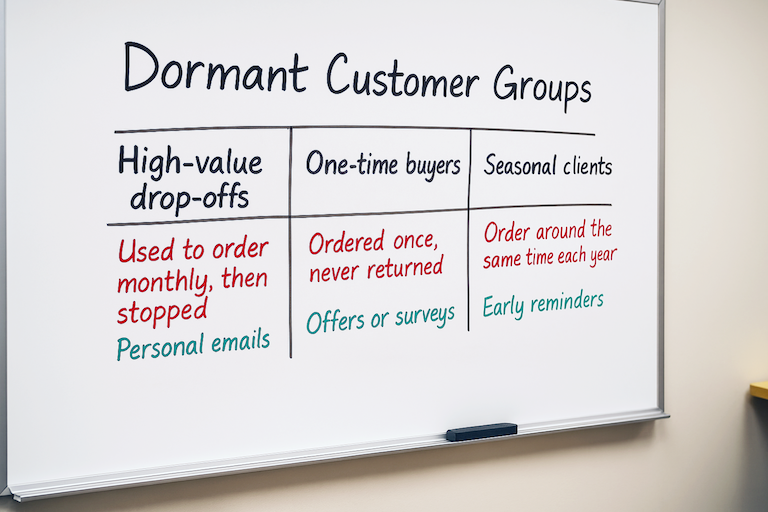
- High-value drop-offs: Customers who used to order monthly and suddenly stopped
- One-time buyers: People who tried the shop once but never came back
- Seasonal clients: Accounts that only seemed to order during the same months each year
Then it proposed strategies:
- Personal follow-up emails for the high-value drop-offs
- Promotional offers or satisfaction surveys for one-timers
- Early reorder reminders for the seasonal group, timed ahead of their usual spike
Clay blinked at the screen.
We already had this data, he thought. But I’ve never seen it laid out like this.
He took the AI-generated report data and quickly laid it out on his whiteboard. The clarity was almost embarrassing. How had he missed it?
This isn’t just customer segmentation, he realized. This is a growth map.
Turning insights into outreach
Clay didn’t try to automate everything. That wasn’t the point.
He selected three names from the high-value drop-off group and used AI to help craft a short, conversational follow-up message.
“Hi [First Name], just checking in. We noticed we haven’t seen an order from you in a while, and I wanted to personally ask how things are going. If your needs have shifted, that’s okay—but if we’ve dropped the ball somehow, I’d love to make it right.”
It sounded like him. And it was easy to personalize.
Meanwhile, Jess walked by and saw the customer list on his screen.
“Planning a campaign?” she asked.
“Kind of,” Clay said. “Trying to re-engage some of our quieter accounts.”
He showed her the seasonal segment and asked if she’d want to draft a few AI-assisted emails timed for early outreach.
“You’re speaking my language,” she smiled. “I’ll take the spring and summer clients—you can have the winter folks.”
By the end of the week, Clay and Jess had sent over a dozen messages. Nothing pushy. Nothing mass-blasted. Just thoughtful touchpoints based on actual data.
Results without a promotion
Within a few days, they had responses.
One old customer replied with an order for outdoor signage—just like they used to get every spring.
Another asked for a quote on a reprint of a catalog they’d produced last year.
None of the messages included discounts. No “limited-time offers.” No urgency gimmicks.
Just relevance.
That’s what caught people’s attention.
The moment it clicks
On Friday afternoon, Clay closed out the week with a quiet moment at his desk. He flipped back through his notes, rereading the AI prompt he’d written at the start of the week.
He jotted a single sentence in his notebook:
AI doesn’t just save time.
It reveals opportunities.
This wasn’t about being flashy. It wasn’t about chasing trends.
It was about clarity. Focus. Smart, intentional next steps.
Why this matters
Printers are problem-solvers by nature. We build processes. We fulfill orders. We put ink on paper and signage on buildings.
But when the day-to-day starts to run smoother, the next step isn’t to coast—it’s to look forward.
And that’s what AI made possible for Clay.
It helped him see. Not just what needed fixing, but what could be nurtured, reclaimed, or grown.
He didn’t buy a list. He didn’t run an ad. He just used the information he already had to reconnect with the customers who already knew him.
That’s not revolutionary. It’s just smart business.
And that’s where AI shines.
Next month in the series
Clay’s team has momentum—but not everyone’s comfortable with how fast things are changing. Next month: how to lead through AI resistance without breaking trust.