
Does It Feel Impossible to Hire the “Right” People Right Now?
If you’ve tried to hire lately, you already know: it’s not just hard to find people who “get print.”
It’s hard to find people, period.
You post a job, wait, refresh your inbox, and maybe a few resumes trickle in. One candidate has solid print experience but freezes up around software and online ordering. Another is great with digital tools but has never walked a job through press and bindery. Meanwhile, when a key estimator or CSR is out, everything slows down, and everyone feels the pressure.
That’s why print shop hiring and cross-training feels so different today. You’re trying to build a team that understands print, can keep up with changing technology, and is flexible enough to cover for each other.
The good news? You don’t have to wait for a mythical “perfect hire” to show up. With a clearer picture of the skills you actually need and some intentional cross-training, you can make the team you already have stronger, more flexible, and more confident.
Print shop hiring and cross-training are about building the right mix of print, customer, digital, and AI-assisted skills so your shop can keep moving no matter the circumstances.
Why the 2026 Skills Mix Is Different for Print Shops
Not that long ago, a lot of shops functioned with pretty defined lanes: press, bindery, prepress, CSR, estimator, and sales. Everyone had a “box” and mostly stayed in it.
Today, those lines are blurrier. Customers expect online ordering. They want quotes yesterday. Jobs may include print, landing pages, QR codes, or email follow-ups. You’re juggling more software, more data, and more communication than ever.

That shift has quietly changed what “qualified” means. A modern print team needs:
- Print craft: the fundamentals that keep quality high and jobs moving.
- Customer skills: listening, setting expectations, handling changes without drama.
- Digital comfort: working inside your MIS, online ordering system, or proofing tools without fear.
- AI comfort: not “AI gurus,” but people who can let AI help with everyday writing, documentation, and simple content.
The challenge isn’t just that there “aren’t good people.” It’s that the bar has moved, and job postings and training plans haven’t kept up.
When you’re clear on the skills your print shop employees need today, a few things happen: you write better job postings, you notice more potential in the people you already have, and you panic less when someone leaves or needs time off.
Start with a Skills Map, Not a Job Posting
Before you post another job, it’s worth pausing to ask a simple question:
“What skills do we want this shop to have two or three years from now?”
That answer is your skills map.
You don’t need software to do this. A legal pad or basic spreadsheet is enough. Start by listing the roles or key areas in your shop: CSR, estimating, prepress, production, sales, etc. Under each heading, jot down what that role actually needs to do in a modern workflow.
Take CSR as an example. Beyond answering phones, they might need to:
- communicate clearly by email,
- understand basic pricing and estimating,
- take and track orders that come in online,
- update job information in your MIS, and
- use AI to help draft everyday responses to common customer questions.
Do the same for estimating, prepress, and production. Estimating might include quoting, scheduling awareness, and using AI to document an SOP on “this is how we quote X.” Prepress might include file prep, reading job tickets, and using AI to help create checklists and training notes.
The point isn’t to create a perfect document. It’s simply to get what’s in your head onto paper, so staffing becomes a print shop staffing strategy instead of a constant series of emergency hires.

Once you’ve listed the skills, look at your current team. For each person, mark where they are strong, where they’re okay, and where they’re “not yet.” Patterns will jump out quickly. You’ll see the roles where one person carries most of the load, skills that a few more people could learn, and spots where a little training would make someone much more valuable and confident.
Suddenly, you’re not thinking, “We just need more people.” You’re thinking, “We need more backup on estimating basics,” or “We’d breathe easier if one more person could handle simple online orders,” or “We could use AI to take some of this writing off their plate.”
That kind of clarity makes both hiring and cross-training a lot less random, even if/when the candidate pool is thin.
When to Hire vs. When to Cross Train (and Where AI Fits)
Once you can actually see your skills map, it becomes easier to decide where hiring is truly needed and where cross-training is the smarter move.
There are moments when hiring really is the right answer. If you’re routinely turning away work or missing deadlines because there literally aren’t enough hours in the week, you probably do need more bodies. If you’re adding a new shift or bringing in new equipment that needs its own operator, the need is obvious. And sometimes there’s a skill you simply don’t have in-house and can’t realistically build quickly.
But many gaps aren’t like that. Often, they’re close enough to what someone already does that cross-training makes a lot of sense. A CSR can learn the basics of estimating so that small, simple quotes don’t always bottleneck at one desk. A prepress tech can learn how to process straightforward online orders and answer simple file questions. A salesperson can learn to use the email or social tools you already have so they stay visible to key accounts.
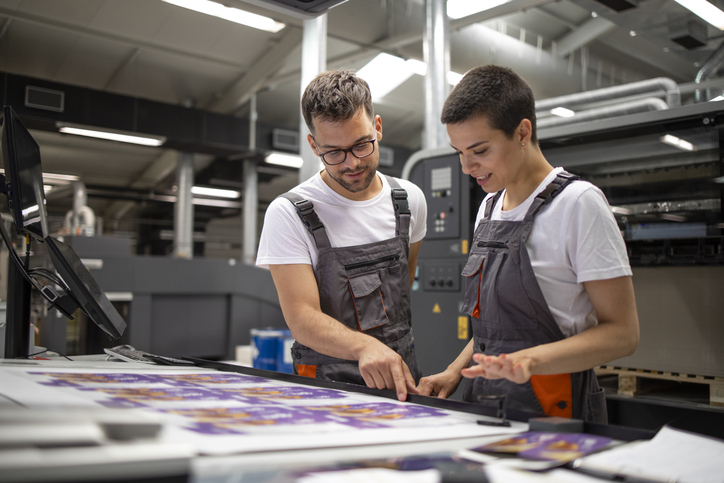
Cross-training is one of the best ways to build resilience into your team. Instead of “we’re sunk if Pat is sick,” you move toward “we’re not thrilled when Pat is sick, but we’ll survive.”
AI fits into this picture as a quiet helper. It’s especially good at the stuff nobody loves doing anyway:
- drafting customer emails that your CSR can tweak and send,
- turning your “this is how we do it” explanations into written SOPs,
- summarizing long instructions into a short checklist for the production floor,
- helping brainstorm subject lines or social posts tied to campaigns you’re already running.
For most shops, AI training isn’t about turning everyone into technologists. It’s about teaching your team where AI can reasonably take twenty minutes of writing off their plate so they can get back to customers and jobs.
That’s a very different conversation from “AI is coming for your job.”
A Simple 5-Step Plan to Build Your Cross-Trained, AI-Enabled Team
You don’t need a big HR department to pull this off. You just need a simple plan you can actually implement:
-
Define the skills your print shop needs in 2026.
Use your skills map to capture the mix of print, customer, digital, and AI-assisted tasks you want this team to handle. -
Map your current team to those skills.
Be honest about strengths, “good enough for now” areas, and gaps. Pay attention to where one person is the only one who knows how to do something important. -
Choose a small number of cross-training moves.
Pick two or three that would make the biggest difference. Maybe that’s training a CSR on simple quotes, teaching someone else how to handle online orders, or having prepress and CSR shadow each other for a day so they understand each other’s world. -
Introduce AI in very specific ways.
Don’t announce a big AI initiative. Show people one or two practical uses: “Let’s use this to draft that long email,” or “Let’s have it help us write a quick checklist for this job type.” Keep it narrowly focused and printer-specific. -
Revisit your hiring plan.
After a bit of cross-training and AI support, look back at your skills map. The gaps that remain are the ones you should hire for when you do find a good candidate. You’re no longer hiring out of panic; you’re hiring on purpose.
This kind of plan doesn’t magically fix the labor market, but it does give you more control over how your shop responds to it.

Common Questions Printers Ask About Hiring, Cross Training, and AI
What skills do print shop employees need in today’s print environment?
They need a mix of print basics, solid communication, comfort with your core software, and a willingness to let AI help with routine writing and documentation. Not everyone needs the same mix, but as a team, you want all of those boxes checked.
How can I improve hiring and cross-training in my print shop?
Clarity is step one. A skills map stops you from hiring blindly and helps you see where cross-training makes sense. From there, start small: a few targeted training moves, plus introducing AI for things like emails, notes, and checklists, can relieve pressure surprisingly quickly.
When should we hire vs. cross-train?
Hire when you truly need more capacity or a completely new skill set that doesn’t exist in-house. Cross-train when the skill is adjacent to what someone already does, and the work can be supported with basic processes and AI-assisted documentation.
How does AI training help my staff work smarter?
Good AI training is practical. It shows your people where AI can help in their day (writing repetitive emails, documenting “how we do things here,” pulling out key points from long instructions), so they can spend more time on customers and quality control and less time staring at a blinking cursor.
Which roles benefit most from AI?
CSRs, estimators, salespeople, and owners tend to see the fastest wins because they spend a lot of time writing and explaining things. Production can benefit too when AI is used to turn experience into clear checklists and simple guides for others to follow.
What to Do Next If You Want a Stronger, More Flexible Team
The labor market is ever-changing, but you’re not powerless while you wait for the next resume to hit your inbox.
You can decide what skills your shop truly needs.
You can build a realistic cross-training plan.
You can let AI quietly handle some of the busywork that wears people down.
Over time, those choices give you a team that’s less fragile when someone is out, more confident with the tools you already own, and better equipped to say “yes” to the kind of work you want more of.
At Marketing Ideas For Printers, we’ve watched shops get breathing room by combining thoughtful staffing plans with printer-specific AI training. If you ever want help showing your team how to use AI in real print-shop workflows, we’re here to support you.
Whether you work with us or not, the main idea is simple:
Don’t wait for the perfect hire.
Start building the skills you need with the people you already have.